Alerts

-
7 minutes, 26 seconds
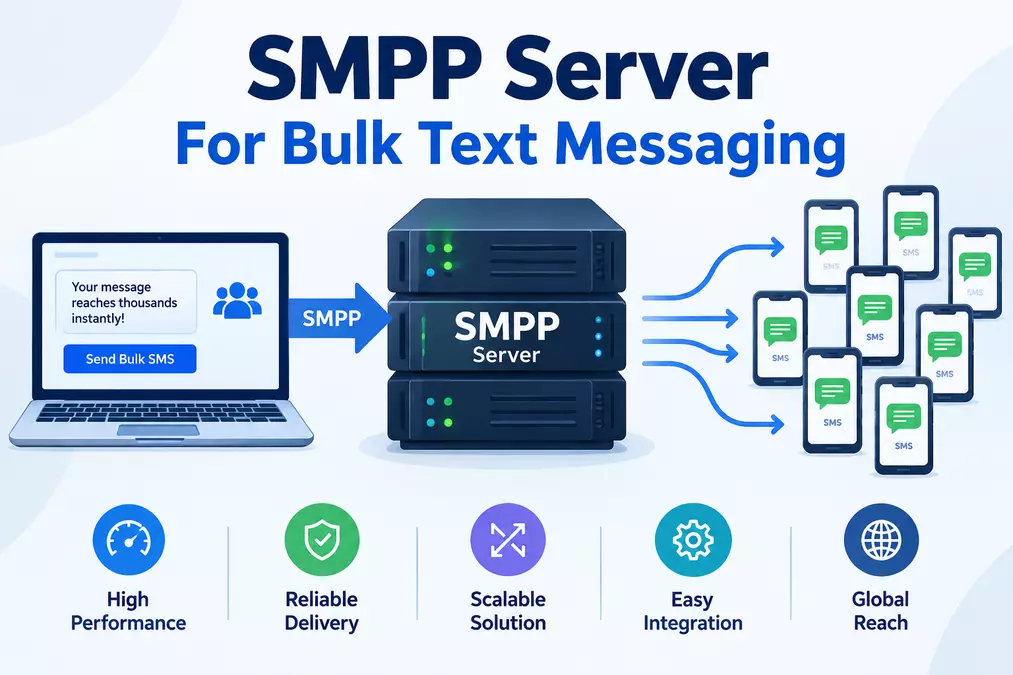
If you've ever pushed ten thousand texts through a cheap web panel, you know how it goes. The first few hundred leave quickly, then everything slows down. Some messages show up an hour late. A few never show up at all, and the panel can't tell you which ones. For a hobby project that's annoying. Banks sending payment notifications and clinics setting appointment reminders for the next day, have a serious issue to address. This problem can be solved by an SMPP server , which should be well understood by everyone prior to spending money on any bulk SMS solutions.
SMPP is short for Short Message Peer-to-Peer. The protocol dates back to the late 1990s & was built so outside applications could talk straight to a mobile operator's message center. Nobody has managed to replace it, mostly because it still does the job better than the alternatives.
Here's the difference in practice. A typical HTTP SMS API works like knocking on a door for every single message: knock, wait for an answer, knock again. SMPP opens the door once and leaves it open. Your software connects, logs in (this is called a "bind") and then pours messages through that one link while delivery reports come back the other way. Less back-and-forth means more messages per second.
Say a retailer wants to send 150,000 sale notifications on a Friday morning. Its system connects to the SMPP server as a client, which the protocol calls an ESME. The server checks the username and password accepts the bind and the submissions begin.
Submit_sm requests transport text messages from your system to your mobile operator's SMS center. The SMS center first finds the recipient's mobile phone and delivers the message. When the mobile phone confirms receipt, a message delivery receipt is routed back to your system. That way you know with certainty which mobile phones received your message.
There's one more trick worth knowing. The protocol Enables windowing which means you can send a batch of messages without waiting for each acknowledgment. Set the window sensitively & one connection can carry hundreds of messages a second. Open several binds and the number climbs further.
Plenty of teams start with an HTTP gateway because it's quick to set up. Many of them move to SMPP once their volumes grow and the reasons are fairly consistent.
Speed is the first one. A steady connection simply moves more traffic than request-by-request calls. The second is feedback receipts arrive almost immediately, so your reports reflect what happened and not what you hoped would happen. Third, you get more say about routes, sender names, priorities and character sets. Cost also tends to drop, since you cut out some of the resellers who each take a small slice per message. And finally there's the heartbeat, called inquire_link, which tells both sides the connection is still alive. When it dies, you find out within seconds.
The core network in the telecom field may be considered as the part of operators' infrastructure in which switching, routing, subscriber's record storage and service provisioning take place. During a text message delivery several modules are involved: message center, register that stores subscriber's location data and switch that routes the text to the subscriber's phone in the end. Your business application has no direct way into any of that and operators wouldn't allow it anyway. The SMPP link is the controlled entrance. It takes your request puts it in a form the operator's equipment accepts and brings status information back out. Understanding this helps when something breaks because you can tell whether the fault sits in your software on the link or deeper inside the carrier's side.
Not every setup performs the same and brochures rarely tell the full story. These are the points I'd look at.
Real throughpu t. Ask what the system continues over an hour not what it hits during a thirty-second demo. A platform that manages 50 messages a second on a quiet afternoon may fall apart at 500 during a flash sale.
Routing and failover . If one operator link slows down traffic should shift to another on its own. Nobody wants to fix that manually at three in the morning.
Tails . Operators throttle senders, so messages need a place to wait. A good queue stops loss and keeps urgent items, like one-time passwords with a two-minute expiry, ahead of the marketing batch.
Logs . The first time a customer insists they never received a code, you'll want a record showing every step with a timestamp. Searchable logs save hours.
Security . Limit connections to known IP addresses use encrypted links where the operator supports them, and change passwords on a schedule. These platforms carry login codes and personal data so treat them like a payment system.
Encoding . English text fits the standard GSM set at 160 characters per message. Hindi, Arabic, Chinese or emoji switch the message to UCS-2 and the limit drops to 70. A decent server splits long texts and joins them again properly so nobody receives garbled sentences.
Almost every country regulates bulk SMS now. India is a good example: companies must register their sender headers and message templates on the operators' DLT platforms, and anything unregistered is simply blocked. Elsewhere you'll find opt-in requirements rules about sending at night and mandatory unsubscribe handling.
Treat these as part of the design from day one. Attach the template ID to every submission keep consent records & honor opt-outs without delay. Skipping this stuff costs more than it saves. Numbers get blacklisted, sender IDs get suspended & a campaign you spent a week preparing goes nowhere.
Some companies write their own server using open-source libraries. That gives full control and suits teams with experienced telecom engineers. The catch is upkeep. Every operator has its own quirks, protocol versions differ, and tuning never really ends.
Others hire specialists. Comcode Tech is one of the companies offering telecom software and messaging infrastructure, which allow businesses to perform reliable bulk delivery of messages without having to develop all technologies internally. Regardless of the option chosen, it is essential to request a test connection, route traffic through it, and contact the company's existing clients to learn about their experience before finalizing the decision. A friendly sales call tells you very little. A test at your real volume tells you a lot.
Most failed messaging projects trip over the same few things.
- Confirm your credentials, whitelisted IPs and bind type with the operator.
- Pick a window size & test it against their limits.
- Set the inquire_link interval so dead connections get noticed quickly.
- Load approved templates and sender IDs.
- Send a pilot of a few thousand real messages and compare submitted numbers with delivery reports.
- Set alerts for queue depth, failure rate & dropped connections.
- Write down who does what when something breaks, so anyone on shift can respond.
Banks send transaction alerts & login codes. Hospitals send appointment reminders which cuts missed visits. Shops announce sales to customers who opted in. Delivery companies tell you the parcel is nearby. Schools warn parents about closures & governments use the same pipes for emergency warnings. Different industries, same basic need: a steady link, a clean route and quick feedback.
An SMPP server is not something that people would be excited about but most of the text messages that people read on their phones pass through one. For this reason it is important for any business that rely on being able to reach their customers in a timely manner to understand how they work, be it one they use themselves or through a third party. It is important to test them under stress, make sure they meet local regulations, review delivery reports, & have an alternate method of sending messages prepared. By doing these things, businesses can help ensure that their messages are being sent out as intended.




Comment