
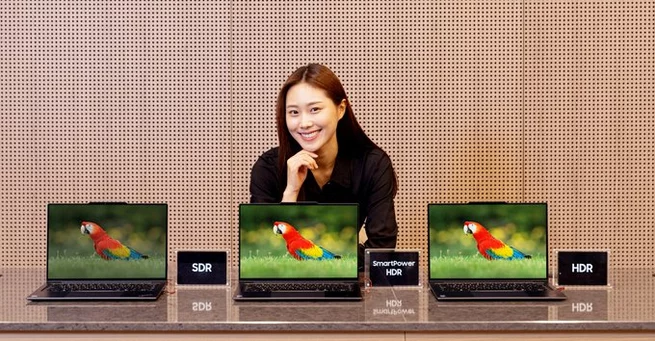
SmartPower HDR Promises Better HDR Battery Life
SmartPower HDR is a new OLED display technology from Samsung Display and Intel designed to solve one of the biggest laptop pain points: HDR battery drain. Users often ask whether HDR is worth enabling on laptops, especially on OLED screens known for vivid colors but heavy power use. According to Samsung, this new approach allows HDR visuals without significantly hurting battery life. The technology dynamically adjusts how much power the display uses instead of locking brightness at maximum levels. That means users no longer have to choose between great visuals and longer battery life. Intel previously teased the feature, but Samsung has now revealed how it actually works. While supported laptops haven’t been announced yet, the potential impact is already drawing attention.
How SmartPower HDR Works Inside OLED Displays
At the core of SmartPower HDR is real-time brightness analysis handled by the laptop’s chipset. Samsung Display explains that the system monitors peak brightness on a frame-by-frame basis as content plays. That data is then passed to the OLED panel’s timing controller chip. Using brightness information and the ratio of active pixels, the display calculates the most efficient driving voltage. This prevents unnecessary power usage when full brightness isn’t required. Unlike traditional HDR modes, the panel isn’t forced to operate at maximum voltage all the time. The result is a smarter display that adapts to what’s actually on screen. This technical shift is what enables meaningful battery savings.
Why Traditional HDR Drains Laptop Batteries
Conventional HDR modes are designed with TVs in mind, not portable devices. On laptops, HDR often stays locked at peak brightness regardless of content type. Even basic tasks like browsing or editing documents can trigger high power usage. Because of this, many laptop manufacturers default to SDR mode to preserve battery life. Users miss out on richer contrast and color accuracy as a result. SmartPower HDR directly addresses this inefficiency. By scaling voltage dynamically, it avoids wasting energy during everyday use. This makes HDR practical again for laptops, not just high-end desktop displays.
Real-World Power Savings Samsung Claims
Samsung Display says SmartPower HDR can reduce OLED pixel power consumption by up to 22% during general usage. Even during HDR-heavy tasks like gaming or video playback, power savings can reach up to 17%. Notably, general usage power consumption is said to be comparable to SDR mode. That’s a major claim for users worried about battery degradation. If accurate, it could change how people use HDR on the go. These improvements also align with Intel’s broader push toward more power-efficient PC platforms. While independent testing is still needed, the numbers are promising.
What This Means for Future OLED Laptops
SmartPower HDR could significantly improve the everyday experience of OLED laptops. Longer battery life paired with consistently better visuals makes OLED more practical for work and entertainment. Content creators, gamers, and casual users alike stand to benefit. The technology also fits into growing industry pressure to balance performance with efficiency. However, Samsung hasn’t confirmed which laptops will support SmartPower HDR or when it will ship. That uncertainty leaves consumers waiting for real products. Still, the collaboration between Intel and Samsung signals strong ecosystem support.
Why SmartPower HDR Matters for the PC Industry
As OLED panels become more common in laptops, power efficiency is no longer optional. SmartPower HDR represents a shift toward adaptive display technologies built specifically for mobile computing. It reflects deeper cooperation between chipset makers and display manufacturers. For users, it removes a long-standing compromise between visual quality and battery life. For manufacturers, it offers a new way to differentiate premium laptops. If widely adopted, SmartPower HDR could make HDR the default instead of a feature users turn off. That change alone could redefine how laptop displays are judged in 2026 and beyond.















Comment