Alerts

-
4 minutes, 41 seconds
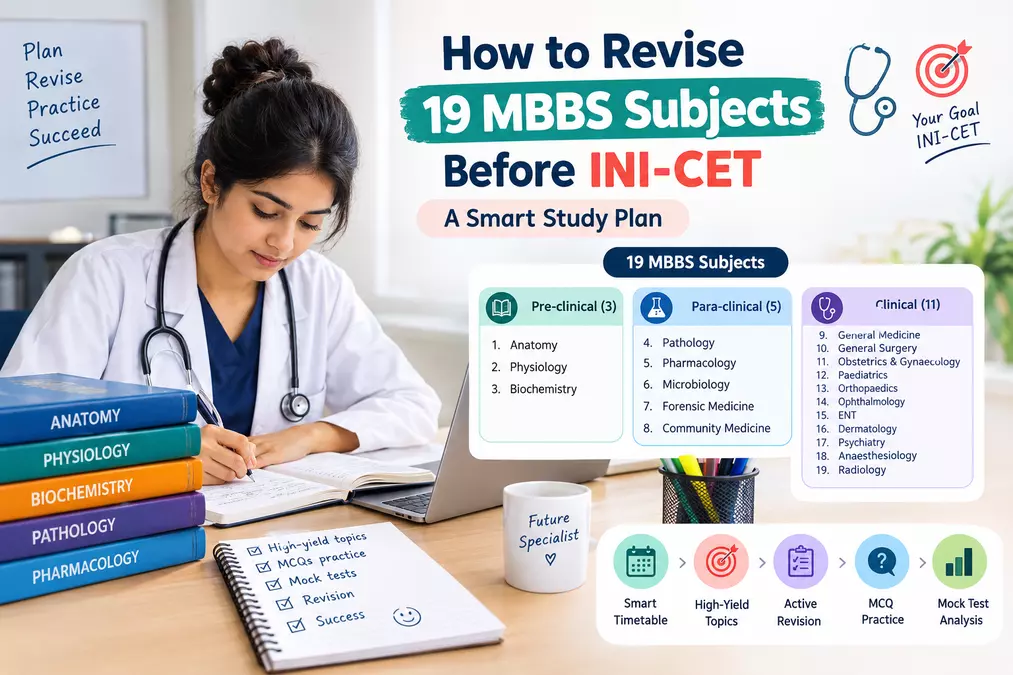
Preparing for the INI-CET exam equires more than completing the syllabus. Medical graduates must revise 19 MBBS subjects, practise multiple-choice questions (MCQs), improve accuracy, and retain important concepts within a limited time. Without a proper revision strategy, it is easy to spend too much time on a few subjects while neglecting others.
A structured INI-CET revision strategy can help you cover all 19 MBBS subjects, identify weak areas, and improve your performance in mock tests. The key is to prioritise high-yield topics, revise actively, and practise questions regularly instead of repeatedly reading textbooks.
Start by organising the 19 MBBS subjects into three groups. This makes your revision schedule easier to manage and helps you allocate time according to your preparation level.
Pre-clinical subjects
Anatomy
Physiology
Biochemistry
Para-clinical subjects
Pathology
Pharmacology
Microbiology
Forensic Medicine
Community Medicine
Clinical subjects
General Medicine
General Surgery
Obstetrics and Gynaecology
Paediatrics
Orthopaedics
Ophthalmology
ENT
Dermatology
Psychiatry
Anaesthesiology
Radiology
Do not allocate equal time to every subject automatically. Give additional revision time to subjects where your concepts are weak or your mock-test accuracy is low.
A realistic timetable helps you revise consistently without feeling overwhelmed. If you have 30 days remaining, you can divide your preparation into three phases.
Days 1–18: First revision
Revise the subjects systematically. Focus on high-yield concepts, important images, clinical correlations, and previously tested topics. Solve subject-wise MCQs after completing each topic.
Days 19–25: Rapid revision
Revisit short notes, flashcards, important tables, drug classifications, diagnostic criteria, and commonly confused concepts. Spend more time on subjects where you repeatedly make mistakes.
Days 26–30: Final revision
Review your error notebook, practise selected mixed-subject MCQs, and take mock tests. Avoid starting large new topics unless they are essential gaps in your preparation.
Adjust this schedule according to your available time and current preparation level. If you have several months, complete more detailed revision cycles before entering the final phase.
For INI-CET preparation, focus on concepts that connect basic medical sciences with clinical practice.
Anatomy: Neuroanatomy, embryology, and important anatomical relations.
Physiology: Cardiovascular, respiratory, renal, and endocrine physiology.
Biochemistry: Metabolism, enzymes, vitamins, and molecular biology.
Pathology: Neoplasia, haematology, inflammation, and systemic pathology.
Pharmacology: Mechanisms of action, adverse effects, and drug interactions.
Microbiology: Organisms, laboratory diagnosis, and antimicrobial agents.
Community Medicine: Epidemiology, biostatistics, screening, and national health programmes.
Medicine and allied subjects: Clinical presentations, investigations, ECGs, and image-based diagnosis.
Surgery and allied subjects: Trauma, surgical emergencies, instruments, and clinical decision-making.
Obstetrics and Gynaecology: Antenatal care, obstetric emergencies, and common gynaecological conditions.
Use this list as a starting point, not as a substitute for the complete syllabus. Review the latest official examination information and your previous mock-test performance before finalising priorities.
Reading the same notes repeatedly can create familiarity without ensuring that you can recall the information during an examination.
Use active recall to strengthen retention. After revising a topic, close your notes and try to answer questions from memory. Explain the concept in your own words, draw a flowchart, or recall the important diagnostic criteria without looking at the answer.
Flashcards are useful for pharmacology, microbiology, biochemistry, and other fact-heavy topics. Review difficult cards more frequently and revisit well-remembered concepts at longer intervals.
This approach makes revision more effective and helps you identify gaps before the examination.
MCQ practice should be part of your daily revision routine rather than something you begin after completing all 19 subjects.
For each question, understand why the correct option is right and why the other options are incorrect. Pay particular attention to clinical vignettes, image-based questions, and questions that test connections between subjects.
Maintain an error notebook with three categories:
Conceptual errors: You did not understand the topic.
Recall errors: You knew the concept but could not remember it.
Careless errors: You misread the question or overlooked a key detail.
Revise this notebook regularly. Correcting repeated mistakes can be more useful than solving large numbers of questions without reviewing your answers.
Full-length mock tests help you practise time management and identify subjects that require further revision. After each test, analyse your accuracy, unanswered questions, time spent, and recurring mistakes.
Do not judge your preparation only by your total score. A lower score may reveal specific gaps that you can address through targeted revision.
Use your analysis to plan the next few days. For example, if pharmacology questions repeatedly cause difficulty, schedule a focused revision session and solve another set of related MCQs.
Many candidates lose valuable preparation time by changing resources repeatedly or trying to make perfect notes from every chapter.
Avoid these common mistakes:
Spending too much time on one difficult subject.
Ignoring short subjects until the final week.
Revising without solving MCQs.
Taking mock tests without analysing mistakes.
Studying late at the expense of adequate sleep.
Starting new resources instead of revising familiar material.
Choose a limited set of reliable resources and revise them multiple times. Consistency and recall are more important than collecting study material.
Revising 19 MBBS subjects before INI-CET becomes manageable when you follow a structured timetable, focus on high-yield concepts, practise MCQs, and review your mistakes. Divide your preparation into clear phases and adjust your schedule according to your strengths and weaknesses.
Most importantly, do not wait until the entire syllabus is complete before testing yourself. Regular revision and mock-test analysis can help you retain concepts and approach the examination with greater confidence.
Build your INI-CET preparation around concepts, practice, revision, and assessment to make every study session count.



Comment