
Alerts
-
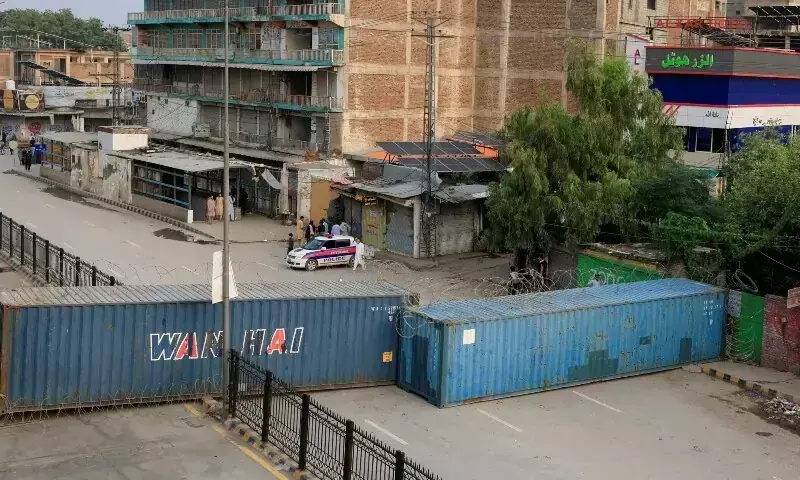
THE federal government on Sunday made good on its threat to dismiss an elected government and impose governor’s rule and emergency in KP. The president obliged. The head of state, the only civilian elected twice to that office, has now imposed governor’s rule three times: Punjab in 2009, Balochistan in 2013, and now KP — though the ruling PML-N is the main driver behind the latest move. His party, the PPP, has done so six times in the short history of Pakistani democracy, the others being in 1973 (Balochistan), 1975 (the then NWFP), and 1994 (again, KP). There is, therefore, nothing novel about Sunday’s move. However, it is a measure that has never achieved what its authors intended, and has more often than not backfired. That, perhaps, is why even those unsympathetic to the PTI government in Peshawar had been warning Islamabad not to take this step. In going ahead with it, the centre assumes responsibility for any blowback. The imposition of governor’s rule in Balochistan in 1973 is instructive. In February of that year, the then prime minister Zulfikar Ali Bhutto dismissed the Balochistan government led by Sardar Attaullah Mengal, and also removed the then governor, Mir Ghaus Bakhsh Bizenjo. The centre ruled directly through Nawab Akbar Khan Bugti and sent in the army, fuelling an already smouldering insurgency. Many elected Baloch leaders turned separatist. The province never really recovered. KP is not Balochistan, and the PTI is no separatist movement. But the parallel of an elected leadership being swept aside on the pretext of security is unmistakable. The experience of the 1973 decision should be seen as a warning that this is how estrangement from the federation begins. There is no political justification for governor’s rule. If the authorities felt terrorism was increasing in some tribal districts and adjoining areas, they could have limited themselves to imposing a targeted emergency under Article 232, as they have already done. To deprive an entire province of its elected government is not only undemocratic; it can also be severely counterproductive, as history shows. The stated reason for Sunday’s decision is terrorism. The real target is perceived to be the only provincial government the opposition held, and the agitation it was leading. The PTI government may have faltered on several fronts, but in a democratic society, those failings are supposed to be addressed through the electoral process, not through executive fiat. Under Article 234, the proclamation lapses within two months unless parliament approves it. That is where this ill-considered action should be challenged on principle: lawmakers would do well to scrutinise it, and the courts to test whether the constitutional threshold was actually met. Islamabad must extricate itself from this quagmire before it deepens, and leave KP’s governance to those its people have elected to oversee it. Published in Dawn, October 12th, 2026









Comment