
Trending
Trending Hashtags
Alerts
-
3 minutes, 37 seconds
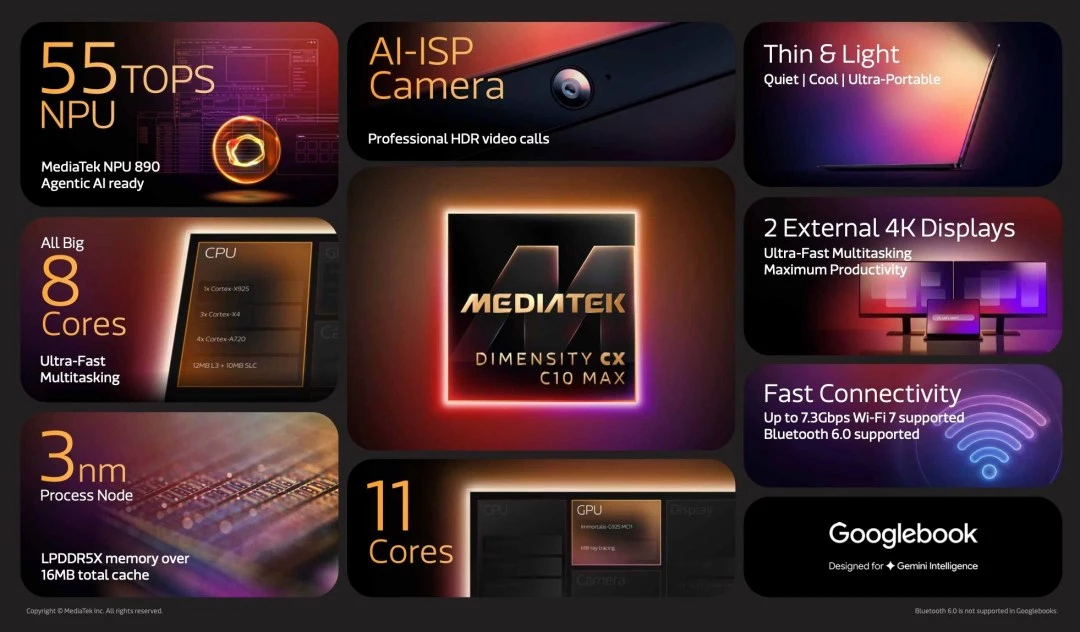
MediaTek has unveiled the Dimensity CX C10 Max, a new processor built for the next generation of thin-and-light laptops. The announcement positions the chip as the company's answer to the growing demand for silicon that can balance everyday performance with serious on-device AI capabilities.
Notably, the Dimensity CX C10 Max is being described as MediaTek's Googlebook chip. That framing points to a machine category that prioritises portability and all-day usability over raw gaming horsepower, a segment where efficiency and battery life matter just as much as peak benchmark scores.
The reveal comes as laptop makers increasingly look beyond the traditional x86 duopoly for alternatives. By entering this space, MediaTek is staking a claim in a market that has become considerably more competitive over the past few years.
MediaTek's decision to lead with the CX C10 Max suggests the company sees AI workloads as the defining feature of the next wave of notebooks. Whether the chip can translate that ambition into real-world adoption will depend on how quickly partners bring designs to shelves.
At the heart of the Dimensity CX C10 Max is an Arm-based design manufactured on TSMC's 3nm process. MediaTek has paired that advanced node with a CPU and GPU configuration aimed at premium thin-and-light machines, giving the chip a foundation that balances performance with the efficiency such laptops demand.
The CPU is an 8-core Arm processor, while graphics are handled by an 11-core GPU. Together, these blocks form the core compute engine of the platform, and the 3nm process helps keep the design within the thermal and power budgets of slim chassis. The combination of an 8-core CPU and 11-core GPU is a notable step up in core count for MediaTek's notebook-class silicon, and it signals that the Dimensity CX C10 Max is intended to handle sustained workloads rather than bursty mobile tasks alone.
MediaTek has not yet detailed clock speeds or specific Arm core types for the CPU and GPU, so the full performance picture will only emerge closer to launch. What is clear is that the 3nm process, 8-core CPU, and 11-core GPU form the hardware baseline for everything else the chip offers.
The Dimensity CX C10 Max doesn't rely on its CPU and GPU alone for AI work. MediaTek has equipped the chip with a dedicated neural processing unit (NPU) rated at up to 55 TOPS — that is, 55 trillion operations per second — putting serious on-device AI acceleration inside a laptop-class SoC.
That figure matters because it determines what kinds of workloads can run locally rather than in the cloud. With 55 TOPS available, the C10 Max is positioned to handle demanding AI tasks directly on the device, from generative models to real-time inference, without leaning on remote servers.
MediaTek has not yet detailed which precisions or sparsity conditions that peak number assumes, so treat 55 TOPS as the headline ceiling rather than a guaranteed figure for every model. Still, it places the C10 Max firmly in the class of silicon built for the current wave of AI PCs, where NPU throughput has become as much a selling point as clock speed once was.
The Dimensity CX C10 Max is the chip that will power Googlebooks, Google's new category of thin-and-light laptops. MediaTek unveiled the processor alongside the first five Googlebooks, which were announced at the same time. This makes the CX C10 Max the silicon that will define the earliest wave of Google's laptop push.
Thin-and-light laptops demand chips that balance performance with efficiency, and MediaTek has built the CX C10 Max with exactly those systems in mind. The 3nm process node, 8-core CPU and 11-core GPU give the platform enough headroom for everyday productivity and light graphics work, while the up-to-55-TOPS NPU enables on-device AI features that Google is expected to lean on heavily across the Googlebook line.
Positioning the CX C10 Max as a Googlebook chip is a significant step for MediaTek. The company has long been a major player in smartphones, but laptops represent a new front. If the first five Googlebooks perform well, the CX C10 Max could establish MediaTek as a serious contender in the thin-and-light segment.








Comment