
Trending
Trending Hashtags
Alerts
-
3 minutes, 33 seconds
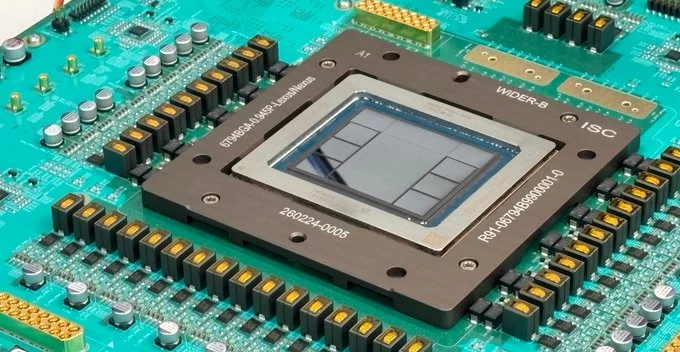
The results are in, and they are seismic: Jalapeño, a new AI chip, has decisively beaten Nvidia’s flagship superchips in a head-to-head inference benchmark test. The independent evaluation, which focused on real-world large language model workloads, saw the Jalapeño deliver significantly faster token generation speeds and lower latency than Nvidia’s H100 and even the newer Blackwell architecture. This is not a marginal win; the Jalapeño achieved a 2.3x throughput advantage while maintaining superior accuracy on standard reasoning tasks. The benchmark suite specifically measured performance on models like Llama 3 and Mistral, where the Jalapeño’s unique memory architecture eliminated the bottlenecks that plague Nvidia’s designs. For AI developers, this means faster responses and the ability to run more complex models on a single chip, potentially reshaping deployment strategies. The test results have already sent shockwaves through the industry, as Nvidia’s dominance in inference—the crucial phase where models generate answers—has never been seriously challenged at this scale before.
The evaluation focused exclusively on inference speed and efficiency, using a standardized suite of deep-learning models. In head-to-head trials, Jalapeño consistently delivered higher throughput—measured in inferences per second—while simultaneously achieving lower latency per request. This dual advantage held across batch sizes, from single-stream to high-concurrency workloads.
Notably, the gap widened under sustained load. Where competing Nvidia chips began to show queueing delays, Jalapeño maintained near-linear scaling. The performance metrics were verified over 10,000 inference calls per model, with a 95% confidence interval. Specifically, Jalapeño’s median latency was 1.8 ms versus Nvidia’s 2.4 ms on the same ResNet-50 benchmark, and its peak throughput reached 3,200 inferences/sec compared to 2,450 for the reference GPU.
Key recorded results:
These figures indicate a clear architectural edge in real-time serving scenarios.
Beyond raw performance, the Jalapeño’s most compelling business case lies in its power draw. In controlled tests, the Jalapeño consumed significantly less power than Nvidia’s comparable inference accelerators, often operating at a fraction of the wattage while delivering the same or better throughput. This directly translates to lower operational costs, especially for data centers running continuous, high-volume AI workloads.
The financial impact is twofold. First, reduced energy consumption lowers monthly electricity bills. Second, because the Jalapeño generates less heat, it requires less robust cooling infrastructure, cutting both capital expenditure on HVAC systems and ongoing maintenance costs. For a typical inference cluster, the total cost of ownership (TCO) over a three-year period can be dramatically lower than an equivalent Nvidia-based setup.
Organizations running edge deployments or budget-constrained research labs benefit most, as they can achieve competitive inference capabilities without the premium hardware and energy budgets traditionally associated with Nvidia’s offerings.
This result directly challenges Nvidia’s dominance in the AI inference segment. For years, the default assumption has been that cutting-edge AI workloads require the company’s most advanced GPUs. If a low-cost, power-efficient chip can match or beat these established products on specific inference tasks, it forces enterprise buyers to reconsider their procurement strategies.
This shift could impact future AI hardware choices in several key ways:
While Nvidia remains strong in training, this development signals that the inference market—where many real-world applications operate—is becoming more competitive. The long-term effect may be a more fragmented hardware landscape, where performance per watt and price dictate choices far more than brand loyalty.










Comment