Alerts

-
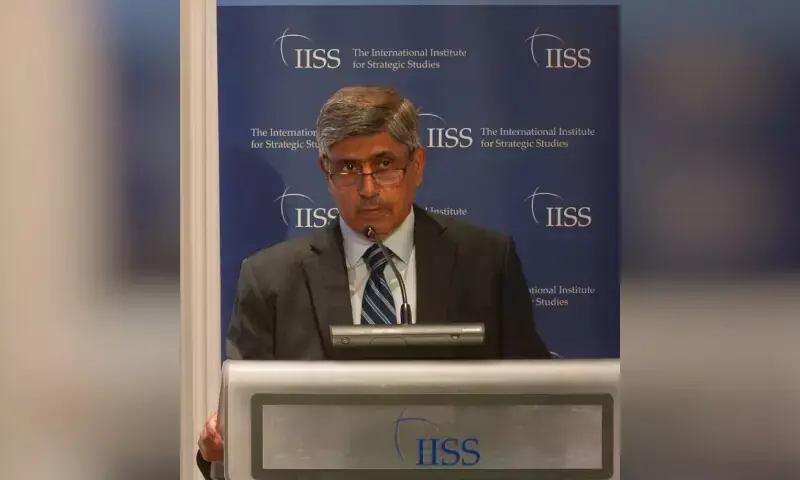
Adviser to the National Command Authority (NCA) and former director general of the Strategic Plans Division (SPD) retired Lieutenant General Mazhar Jamil has warned of the “risky” outcome for South Asia and beyond of a “dangerous ideology” shaping the Indian military mindset. “Indian military thinking is being shaped by a dangerous ideology, which conflates mythology with national power. The outcome is very risky and delusional Indian military doctrines with a poor strategic sense of nuclear realities are endangering South Asia and beyond,” he said in his key note address at a workshop titled ‘Nuclear Deterrence and Strategic Stability in South Asia’. The workshop, held last week in London, was organised by the International Institute for Strategic Studies, which shared a transcript of Jamil’s address late on Monday. He began by saying that a strategic stability model for a region must take into consideration the political beliefs and strategic thinking of states, which formed the basis of policies. And that shaped the strategic and security environment in the region, he explained. “The political and strategic thinking of states, therefore, should prefer [a] political approach because military adventurism, hegemonic ambitions are highly risky and unaffordable in the South Asian nuclearised environment,” Jamil stressed, before specifically talking about India and Pakistan. The two South Asian rivals, he said, had outstanding disputes, Kashmir being the core one. “It needs to be resolved as per the United Nations Security Council resolutions. But, what we are seeing, on the contrary, is [an] Indian political approach of avoiding the resolution of conflict, because perhaps the Indian leadership believes it has no locus standi on Kashmir when it is presented on the multilateral forums,” Jamil said. He added that India “tries to manage [the] Kashmir conflict with military violence within occupied Kashmir and through military aggression against Pakistan. This has not worked, and therefore Kashmir remains a nuclear flashpoint, seriously impacting the South Asian strategic and security environment”. The security perceptions in South Asia had not evolved in a vacuum, Jamil continued. “Indian revisionist and hegemonic political aspirations have [a] long history of Indian coercion and militant violence against all [of] its neighbours. Indian political ideology is based on its mythological concept of violence and revisionism, according to which South Asia, they believe — this traditional belief — that it belongs to [the] Hindu civilisation. “And, not surprisingly, the country was given a dual name in the constitution, India, that is Bharat, clearly defining the strategic direction of the state to be Bharat,” he said. Jamil said Bharat was essentially a “revisionist concept that is rooted in reclaiming [the] vast landmass of South Asia and its domination by Hindu civilisation”. “Indian political forces, interestingly, do not shy away anymore in projecting what previous governments pursued covertly. Very surprisingly, the map of Mahabharat, the greater Bharat, as they call it, covering [the] entire landmass of South Asia, is on the display in the Lok Sabha. That’s the parliament of India, clearly giving the political direction to the state and the state organisations. “So, no wonder, beyond [the] core nuclear diet of India–Pakistan, India’s conflict with all other countries serves as a perpetual driver of [the] evolving security dynamics in South Asia,” he added. He also mentioned a recent “political transformation, led by the extremist Hindutva doctrine, that seeks to marginalise and delegitimise [the] non-Hindu population of the state, especially the Muslims”, in India. “This has introduced an additional layer of complexity to the regional security environment. This marks a significant shift towards a nationalism, which is prejudiced by extreme theological principles,” Jamil said. “So, what we see is that we have a nuclear-armed neighbour whose political and strategic thinking is subordinated to a revisionist, mythological outlook with an overconfidence to subdue its neighbours. This dangerous political philosophy has trickled into the Indian political, strategic, organisational and even societal culture.” The NCA adviser went on to say that this mindset had also, “unfortunately, penetrated deeply into Indian military thinking”. Two diametrically opposing strategic approaches Continuing his criticism, Jamil said it seemed that the Indian leadership was “frozen in time and is unable to break the shackles of history”. “Indian political- and mythological-laced stubbornness is not allowing India to realise three very fundamental but significant conclusions and lessons,” he said, adding that those lessons were vital for strategic stability in South Asia. He said the first of those lessons was that conflicts outlasted military adventurism and wars, unless they were resolved politically. “The resolution of the Kashmir conflict, therefore, needs a political approach and dialogue to achieve stability at [the] higher political planes,” he asserted. The second lesson, he said, was that any military misadventurism between two nuclear powers could only escalate the crisis to undesirable consequences and could not serve any purpose to the policy. In this connection, he added that the Indian leadership needed to understand that it “cannot dictate its unjustified and illegal policy objectives through military aggression to another nuclear power”. Moving on to the third lesson, Jamil said it was “pivotal to the crisis dynamics of South Asia”. He then cited military scholar Carl von Clausewitz, who Jamil said had warned that “war is the realm of uncertainty and escalation is really a control ladder”. Elaborating further, he said: “War is the realm of uncertainty and the lesson from the history of warfare and theory alike is clear. Wars that begin with confidence and control often end with the realisation that control was illusory. “In a nuclearised environment of South Asia, that realisation may come too late to manage safely, if [the] Indian policy of provocation with [a] false sense of achieving escalation domination continues.” Resultantly, he said, “what we are seeing in South Asia are two diametrically opposing strategic approaches, directed by the political ideology of India and Pakistan […] which define the strategic and security environment of South Asia”. The Indian strategic approach, he said, sought political and military dominance to be a “regional hegemon with a revisionist political thinking”. Whereas Pakistan’s strategic approach was directed at the resolution of conflicts through a political process with shared prosperity and to defend the sovereignty with strength against a “regional bully”, he added. ‘Irresponsible nuclear behaviour’ He then shared his views on how the global geopolitical environment and emerging destructive technologies were impacting the strategic stability of South Asia. “To me, there are three major outcomes of [the] contemporary global strategic environment that have influenced [the] Indian leadership’s strategic thinking and behaviour,” he said. He said first of those outcomes was that in the Asia-Pacific balance-of-power struggle, India presented itself as a net security provider, to exploit this geopolitical competition for its own global power-projection ambitions. “The US and Western powers did not dig deep into the actual political motives and capacity of India, [and] rather were too quick to grant this status to India. This, however, gave India a false sense of hegemony in the region,” he said. The second outcome, Jamil said, pertained to the support by Indian technology partners and, “very strangely, also allowing India to get a Nuclear Suppliers Group waiver, in spite of its irresponsible nuclear behaviour”. “Resultantly, India, now, is running one of the fastest-growing nuclear and missile programmes. This has been done with no regard and concern to arms control, a key factor in the strategic stability for the region. So, we now see India developing intercontinental ballistic missiles and submarine-launched ballistic missiles to reach the entire globe, with eight reactors outside International Atomic Energy Agency (IAEA) safeguards.” Pointing out that India was not a party to the Treaty on the Non-Proliferation of Nuclear Weapons, he said its reactors outside IAEA safeguards “are operating as a potential source of fissile material for nuclear weapons”. “From the nuclearisation of South Asia in 1974 to the nuclearisation of the Indian Ocean by Bharat speaks of its global power ambitions. I think what [we] should now worry about is this ambitious and revisionist state reaching to most of their capitals with no restraints and transparency, even to its own technology partners,” Jamil said. He said the third outcome was about the policy of appeasement by “certain powers that has made India think that its exceptionalism will always be acceptable to the world”. “Indian propaganda and [its] disinformation campaign was accepted without scrutiny and responsibility. No questions [were] asked to India about its human-rights violations in Kashmir and against minorities, where state institutions and Hindu extremists [are] conducting heinous crimes as a state policy,” he said, adding that it was only a matter of time before internal uprising in India-occupied Kashmir boiled over. “That will have a serious impact on the security and stability of our region,” he warned. In parallel, he said, India’s access to advanced technologies, space-based capabilities, dual-use weapons systems were also impacting strategic stability. “Dual-use platforms with precision-guided systems have blurred the lines between conventional and nuclear technologies, making it more dangerous for South Asia, due to its geographical proximities and also the sensitivities”. “This also has to be seen against the backdrop of the irresponsible behaviour of India. The case in point is the intentional BrahMos missile attack on Pakistan on 9 March 2022. Strangely, it took India 48 hours to tell its nuclear neighbour about this incident,” Jamil recalled. He added, “While India claimed this to be an accident, it speaks volumes about the dysfunctionality of Indian command-and-control systems, and maybe the presence of some rogue elements in their organisation, because India never shared the findings of [its] investigations for [the] sake of transparency and building some trust.” Likewise, the launch of dual-capable BrahMos missiles during the four-day military conflict between Indian and Pakistan in May 2025 “was a deliberate act of provocation that could have caused catastrophic miscalculation”, Jamil said. “So, it complicates the regional security dynamics, which already lacks institutionalised confidence-building measures and an arms-control mechanism aligned with the emerging technologies.”








Comment