Alerts

-
6 minutes, 50 seconds
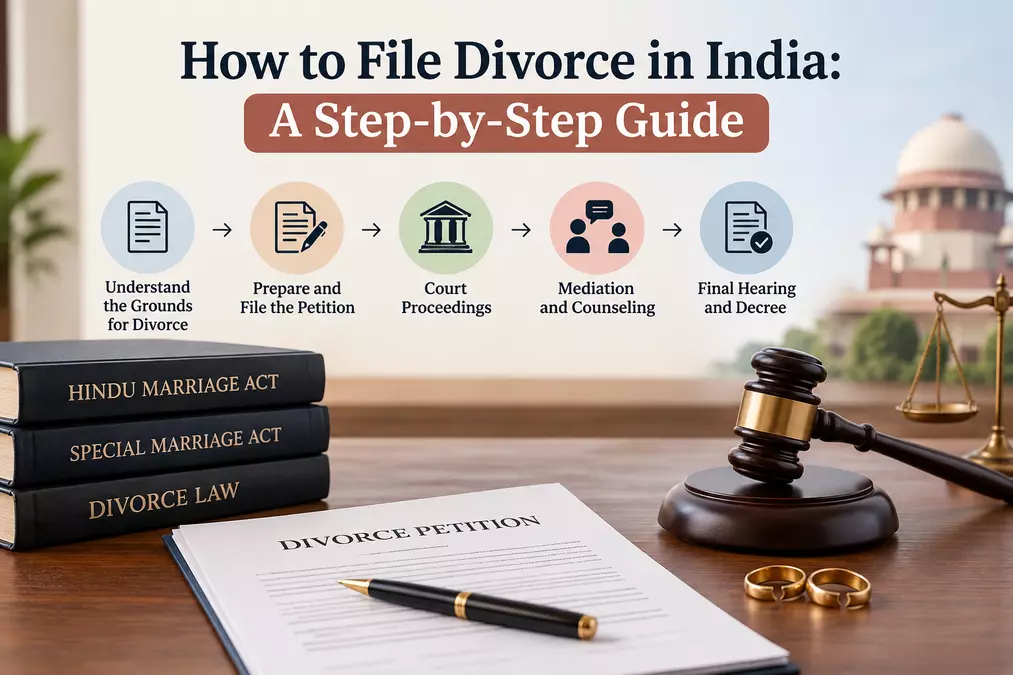
Understanding How to File Divorce in India can feel overwhelming when you're already dealing with the emotional weight of a marriage ending. Between legal terminology, documents, court appearances, maintenance, child custody, and financial arrangements, there's plenty to think about. The good news? Breaking the process into manageable steps makes it much easier to understand. The exact law and procedure depend on factors such as the law governing the marriage and whether the divorce is mutual or contested, so knowing where your case stands is the sensible place to begin.
Before paperwork enters the picture, understanding whether the divorce is mutually agreed or contested is crucial when learning How to File Divorce in India.
In a mutual consent divorce, both spouses agree to end their marriage and generally try to settle connected matters such as maintenance, custody, financial arrangements, and other outstanding issues.
For marriages governed by the Hindu Marriage Act, 1955, Section 13B provides for divorce by mutual consent where the statutory requirements are met. Among other things, it requires the parties to have been living separately for one year or more and to have mutually agreed that the marriage should be dissolved.
Things are different when one spouse wants a divorce but the other doesn't agree, or when there's disagreement over the legal grounds or related issues.
A contested petition must rely on a legally recognised ground under the law applicable to the marriage. The petitioner may also need evidence supporting the allegations made before the court.
In short, you can't simply copy somebody else's petition and hope for the best. The facts matter.
Divorce proceedings are generally brought before the court having appropriate jurisdiction. Family Courts have jurisdiction over proceedings between spouses concerning matters including dissolution of marriage in areas where such courts have been established.
Which court has territorial jurisdiction can depend on the statute governing the marriage and facts such as where the marriage was solemnised, where the parties lived together, or where a spouse currently resides.
Getting jurisdiction right matters. Filing in the wrong place can create delays before the real issues are even considered.
India doesn't have one identical divorce provision covering every marriage.
The applicable framework can vary according to how the marriage was solemnised and the law governing it. Therefore, the first practical step is identifying the relevant statute or personal law.
This distinction affects matters such as:
Grounds for divorce
Eligibility requirements
Court procedure
Waiting periods
Available matrimonial remedies
Rather than making assumptions based on another couple's experience, understand the legal framework applying specifically to your marriage.
Here's where a little organisation can save a lot of running around later.
Documents will differ from case to case, but commonly relevant records can include:
Marriage certificate or marriage-related documents
Identity and address proof
Wedding photographs, where relevant
Income and financial documents
Children's birth certificates
Property or asset-related records
Relevant court or police documents
Communications connected with disputed facts
Existing maintenance or custody orders
For contested proceedings, evidence relating to the particular legal ground may become especially important.
Don't alter, manufacture, or selectively edit evidence. Preserve relevant original records wherever possible.
Divorce isn't always only about formally ending the marriage.
Questions about maintenance, custody, visitation, education expenses, residence, belongings, assets, and other financial arrangements may need attention too.
In mutual cases, spouses may be able to settle some or all of these matters before approaching the court. Clear terms can reduce the chances of another dispute popping up down the road.
Where children are involved, their welfare is an important consideration in custody-related decisions.
Once the legal route and jurisdiction are identified, the appropriate divorce petition can be prepared.
The petition generally sets out relevant information concerning the marriage, parties, circumstances leading to the proceeding, legal basis for seeking relief, and the relief requested from the court.
Accuracy matters.
Dates, events, addresses, previous proceedings, and material facts shouldn't be treated casually. Inconsistencies can complicate an already difficult dispute.
A Divorce Lawyer in Delhi can help someone filing within the appropriate Delhi jurisdiction understand the applicable law, prepare pleadings, organise documents, and identify the relief that may be legally available.
What happens next depends heavily on whether the case is mutual or contested.
In a contested matter, the other spouse will ordinarily have an opportunity to respond. The proceeding may then involve pleadings, applications, evidence, arguments, and hearings depending on the issues involved.
Courts may also explore possibilities for settlement or reconciliation where legally appropriate.
A contested matter isn't necessarily decided in one or two appearances. If evidence is disputed or several connected applications are pending, proceedings can naturally become more involved.
Under Section 13B of the Hindu Marriage Act, the statute provides for a subsequent motion not earlier than six months after presentation of the mutual-consent petition and not later than eighteen months after that date.
However, court decisions have recognised circumstances in which the six-month period can be waived. So, it shouldn't automatically be assumed that every mutual divorce must follow exactly the same practical timeline.
Similarly, Section 14 ordinarily restricts presentation of a divorce petition under the Act within the first year of marriage, subject to its statutory exception for cases involving exceptional hardship or exceptional depravity.
The specific facts and applicable law therefore need to be checked before calculating a timeline.
When allegations are disputed, saying something happened isn't necessarily enough. The court decides the case on the material legally placed before it.
Depending on the dispute, evidence might involve documents, communications, financial records, witnesses, medical material, official records, or other admissible evidence relevant to the pleaded grounds.
More paperwork isn't automatically better.
Relevant, authentic evidence that actually supports the issues before the court matters more than dumping hundreds of unrelated pages into the case file.
The marriage isn't dissolved merely because a petition has been filed.
The court ultimately needs to grant a decree of divorce where the applicable legal requirements are satisfied. Under the Hindu Marriage Act, remarriage is permitted after dissolution when there is no right of appeal, or the appeal period has expired without an appeal, or an appeal has been filed and dismissed.
Keeping a certified copy of the final decree is sensible because it can become an important legal record later.
There's no single timeline that fits every divorce case in India.
The duration can depend on whether the matter is contested, the applicable legal framework, complexity of disputes, evidence, settlement discussions, connected applications, and the court's schedule.
Be wary of anyone guaranteeing an exact completion date without examining the case. Courts, opposing parties, procedural developments, and disputed evidence aren't under one person's control.
Divorce is stressful enough without adding avoidable complications. Try not to:
Hide important facts from your lawyer
Sign settlements without understanding them
Ignore court notices
Miss important dates or hearings
Delete potentially relevant records
Make assumptions about custody or maintenance
Rely entirely on another person's divorce experience
Treat social-media advice as case-specific legal guidance
A clear head and organised paperwork can go a surprisingly long way.
Filing for divorce in India becomes easier to understand when the process is divided into stages: identify the applicable law, determine whether the case is mutual or contested, establish jurisdiction, gather documents, address connected financial or child-related matters, file the appropriate petition, and follow the court process through to the decree.
Every marriage and separation has its own facts. That's why online guides are useful for understanding the broad process but shouldn't substitute for legal advice tailored to an individual case. Before filing or signing a settlement, understanding your legal rights, obligations, and available remedies can help you make informed decisions at each stage.




Comment