Alerts

-
6 minutes, 11 seconds
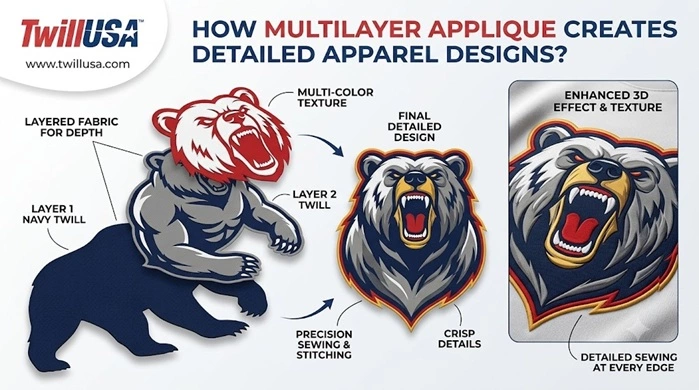
Multilayer applique is a practical technique for creating detailed logos, lettering, graphics, and decorative elements on apparel. By combining multiple layers of fabric or heat-applied materials, designers can build designs with different colors, textures, and visual dimensions. Custom applique makes this approach especially useful for athletic uniforms, team apparel, branded garments, and other applications where precise detailing matters.
Unlike a single-layer design, multilayer construction allows each part of the artwork to serve a specific visual purpose. Borders, shadows, lettering, symbols, and color sections can be produced as individual pieces and assembled into one finished design. This approach also works alongside other apparel decoration methods, including heat transfer numbers, depending on the requirements of the garment.
Multilayer applique involves placing two or more cut materials together to create one finished design. Each layer can have a different color, shape, or material, allowing the design to reproduce details that may be difficult to achieve with a single piece of fabric.
A typical multilayer design may include:
A base layer that establishes the main shape.
A second layer that adds contrasting colors.
An outline that defines letters or graphics.
Smaller elements that provide additional detail.
Specialized materials that introduce different textures or finishes.
With custom applique, these individual components can be prepared according to the specific artwork instead of relying only on standard designs.
One of the biggest advantages of multilayer applique is the ability to separate colors within a design. Instead of printing or stitching every color into one surface, each color can be represented by a separate cut piece.
For example, a sports logo containing three distinct colors can be constructed using three coordinated layers. The pieces are positioned precisely to reproduce the original artwork while maintaining clear boundaries between colors.
This makes custom applique suitable for logos and graphics that require recognizable color separation.
Outlines can make lettering and logos easier to see against the garment. A multilayer approach allows a contrasting border to be positioned around a primary shape.
A white letter with a dark outline, for example, can be constructed using separate layers. The border adds definition without requiring the entire design to be created as one piece.
The same principle can complement heat transfer numbers, particularly when athletic uniforms require clearly defined names, numbers, and graphic elements.
Layering can also create a sense of depth within an otherwise flat apparel design. Different materials, colors, and shapes can be arranged to make particular elements stand out.
The effect does not necessarily mean the design becomes physically thick. Instead, careful positioning and contrast can create visual separation between different parts of the artwork.
The quality of a multilayer design depends heavily on accurate cutting and positioning. Even small inconsistencies can become noticeable when several pieces need to align.
For this reason, digital artwork preparation and precision cutting are important parts of the process. Properly prepared files help define the exact shapes, dimensions, and relationships between individual layers.
Precision is particularly important when:
Multiple layers share the same edges.
Small lettering is included.
Logos contain intricate shapes.
Borders need consistent spacing.
Several garments require matching designs.
Professional custom applique production can help maintain consistency across repeated apparel orders.
Not every layer needs to use exactly the same material. Depending on the desired appearance and application method, different fabrics or heat-applied materials may be selected for different elements.
Material selection may affect:
Color and contrast
Surface texture
Flexibility
Thickness
Application requirements
Overall appearance
Tackle twill, sports twill, felt, HTV, and other materials may serve different purposes within apparel decoration. When custom applique is being developed, selecting compatible materials is important for creating a cohesive finished design.
Athletic uniforms frequently combine lettering, numbers, team logos, and other identifying graphics. A multilayer approach provides flexibility when these elements need contrasting colors or additional visual definition.
For instance, a team number may require a primary color with an outline, while the team logo may use several layers to reproduce its official design.
Heat transfer numbers can be incorporated into broader uniform decoration strategies alongside applique elements, helping create a coordinated appearance across jerseys and other athletic garments.
Good multilayer results begin with properly prepared artwork. Before production, the design should be reviewed to determine which elements require separate layers and how those layers will interact.
Important considerations include:
Number of colors
Layer order
Design dimensions
Minimum detail size
Material compatibility
Placement on the garment
Required application method
Clear artwork files can make the cutting and assembly process more predictable. For custom applique, vector-based artwork is particularly useful when precise shapes and scalable dimensions are required.
Multilayer applique is useful across a range of apparel applications. Its ability to reproduce detailed designs makes it suitable for organizations that need recognizable branding or coordinated garments.
Common applications include:
Sports jerseys and uniforms
School apparel
Team merchandise
Corporate apparel
Club and organization garments
Promotional clothing
Performance apparel
Custom branded uniforms
When combined with heat transfer numbers, multilayer designs can also support complete athletic uniform packages that include player identification and team branding.
A well-planned multilayer design can provide several practical benefits for apparel decorators and garment producers.
Multiple layers allow designers to work with more colors, shapes, borders, and material combinations than a basic single-layer design.
Digitally prepared and accurately cut layers can help reproduce the same design across multiple garments.
Different colors and materials can make lettering and graphics easier to distinguish against the garment.
Depending on the application, applique can provide detailed visual elements without requiring every component to be fully embroidered.
Businesses, schools, and sports organizations can reproduce logos and other distinctive artwork according to their specific requirements.
These benefits make custom applique a useful option when apparel requires more detailed decoration than a simple one-color design.
Before submitting artwork, it is useful to consider the final garment, design dimensions, materials, and application method. A design that looks excellent on a large jersey may require adjustments when produced at a much smaller size.
Consider:
Design complexity: Determine how many separate layers are needed.
Color selection: Check that adjacent layers provide enough contrast.
Material choice: Select materials appropriate for the garment and application process.
Artwork quality: Provide clear, production-ready artwork whenever possible.
Final size: Review small details to ensure they remain practical at the intended dimensions.
Application requirements: Confirm whether the design will be sewn, heat applied, or produced using another method.
These considerations help ensure that the finished custom applique accurately reflects the intended artwork.
Multilayer applique provides a structured way to build detailed apparel graphics from multiple precisely cut components. By separating colors, outlines, shapes, and decorative elements into individual layers, designers can create designs with greater visual definition and material flexibility.
For sports uniforms, branded garments, and specialty apparel, this approach can also work alongside heat transfer numbers and other decoration techniques to create coordinated finished products. With carefully prepared artwork, suitable materials, and precise cutting, multilayer custom applique can turn complex graphics into clean, repeatable apparel designs.



Comment