Alerts

-
6 minutes, 51 seconds
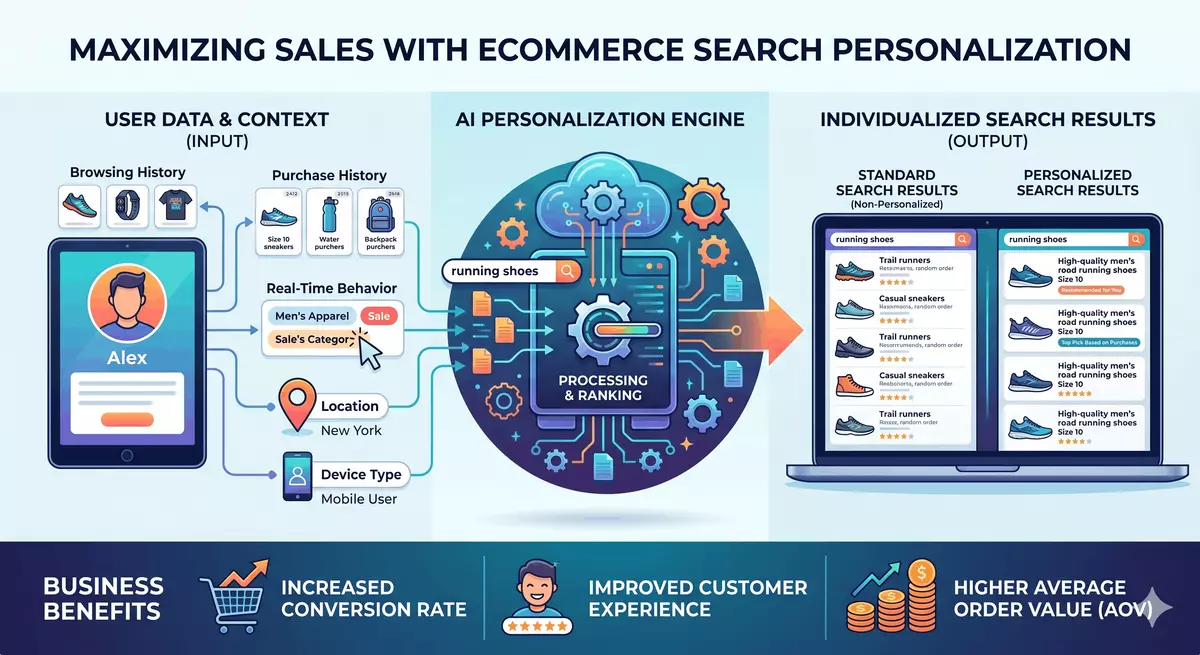
In ecommerce, search and product discovery are often treated as separate functions. Search is viewed as a tool for customers who know what they want, while discovery is associated with browsing, exploration, and inspiration. However, modern shopping journeys rarely fit neatly into these categories. Customers frequently begin with a broad idea, refine their interests as they interact with products, and ultimately discover items they did not initially know they wanted.
This shift in consumer behavior has created a new challenge for retailers. Traditional search systems are designed primarily to retrieve products based on keywords, while discovery experiences often rely on category navigation, merchandising, or recommendations. As product catalogs expand and customer expectations continue to rise, retailers need a way to connect these experiences seamlessly.
Ecommerce search personalization is helping bridge this gap. By combining search intent, customer behavior, contextual signals, and artificial intelligence (AI), personalized search systems can move beyond simple product retrieval and actively support product discovery. Rather than acting as a standalone utility, search becomes a dynamic experience that helps customers explore, evaluate, and discover relevant products more efficiently.
As digital commerce becomes increasingly customer-centric, search personalization is evolving into a powerful engine for both search and discovery.
Although closely related, search and discovery serve different customer needs.
Search typically occurs when customers have a specific goal or product in mind.
Examples include:
Search is often driven by explicit intent.
Discovery occurs when customers are exploring possibilities.
Examples include:
Discovery is often driven by curiosity and evolving preferences.
In reality, most customer journeys involve elements of both search and discovery.
Traditional ecommerce experiences often separate these functions.
Customers may:
This disconnect can create friction and reduce engagement.
Retailers that successfully connect search and discovery can create more intuitive and satisfying shopping experiences.
Historically, ecommerce search engines focused on keyword matching.
When customers entered a query, the system attempted to retrieve products containing those terms.
While useful, this approach has several limitations.
Keyword matching does not always capture customer goals.
Every customer often sees similar results.
Search focuses on retrieval rather than exploration.
Customer context is often ignored.
These limitations prevent search from supporting broader discovery journeys.
Ecommerce search personalization tailors search experiences based on customer behavior, preferences, intent, and contextual signals.
Rather than presenting identical results to every shopper, personalized search engines evaluate factors such as:
The goal is to deliver search experiences that are both relevant and exploratory.
Intent is the foundation of effective search personalization.
Customers often reveal intent through:
Personalized search systems analyze these signals to understand what customers are trying to accomplish.
This enables more relevant product recommendations and discovery opportunities.
Customers do not always know the exact product they want.
For example:
A customer searching for "comfortable work shoes" may be interested in multiple categories, styles, or brands.
Personalized search engines can identify related products and broader solutions rather than limiting results to exact keyword matches.
This supports discovery while maintaining relevance.
Customer behavior provides valuable context.
Important signals include:
These signals help search systems surface products that align with evolving customer interests.
This transforms search into a discovery experience.
Traditional search rankings are often based on product popularity or keyword relevance.
Personalized search systems adjust rankings based on individual customer preferences.
For example:
Two customers searching for "dress" may see different results based on:
This improves both search relevance and discovery outcomes.
Modern search experiences increasingly incorporate recommendation engines.
Search pages can display:
These recommendations help customers explore options they may not have considered initially.
This strengthens discovery.
Many customers begin with broad searches such as:
These searches often indicate exploration rather than specific intent.
Search personalization helps refine results using customer context, making broad searches more useful and engaging.
Large product assortments often create discovery challenges.
Personalized search helps customers navigate these catalogs by:
This reduces search effort while improving discovery opportunities.
Customer interests can change rapidly.
Modern search personalization systems analyze real-time interactions such as:
This allows search experiences to adapt dynamically as customers explore products.
The result is a more responsive and discovery-friendly experience.
Many customers discover products outside their original search category.
For example:
A customer searching for hiking boots may later become interested in backpacks, outdoor apparel, or camping accessories.
Search personalization helps identify these relationships and encourage relevant exploration.
This increases engagement and basket size.
Customers interact across:
Search personalization can leverage cross-channel insights to create more consistent discovery experiences.
This improves continuity throughout the customer journey.
Artificial intelligence plays a critical role in connecting search and discovery.
AI-powered systems can:
Machine learning continuously improves as more customer interactions occur.
This enables increasingly sophisticated discovery experiences.
Semantic search focuses on understanding meaning rather than matching exact keywords.
It helps search systems:
Semantic capabilities significantly enhance discovery opportunities.
Customer Data Platforms (CDPs) strengthen search personalization by creating unified customer profiles.
A CDP consolidates:
These insights improve both search relevance and discovery effectiveness.
Customers find relevant products more quickly.
Results better align with customer needs.
Customers interact with more products.
Relevant experiences support purchasing decisions.
Cross-category discovery creates additional purchase opportunities.
Experiences become more intuitive and helpful.
Maintaining relevance becomes increasingly complex.
Customer information often exists across multiple systems.
Personalized search requires rapid decision-making.
Customers expect increasingly sophisticated experiences.
Addressing these challenges is critical for success.
Machine learning improves relevance and exploration.
Customer actions provide valuable context.
Meaning-based search supports discovery.
Recommendations encourage exploration.
Comprehensive customer data strengthens personalization.
Organizations should monitor:
These metrics help evaluate search personalization effectiveness.
The distinction between search and discovery is becoming increasingly blurred in modern ecommerce. Customers no longer follow linear shopping journeys and often move fluidly between searching for specific products and exploring new possibilities.
Ecommerce search personalization bridges this gap by combining intent understanding, behavioral insights, AI-driven decisioning, semantic search, and personalized recommendations. Instead of simply retrieving products, search becomes an intelligent experience that guides customers toward relevant discoveries and purchasing decisions.
As ecommerce catalogs grow and customer expectations evolve, retailers that successfully integrate search and discovery through personalized search experiences will be better positioned to improve product discovery, increase conversions, strengthen customer engagement, and drive long-term growth.


Comment