Alerts

-
4 minutes, 52 seconds
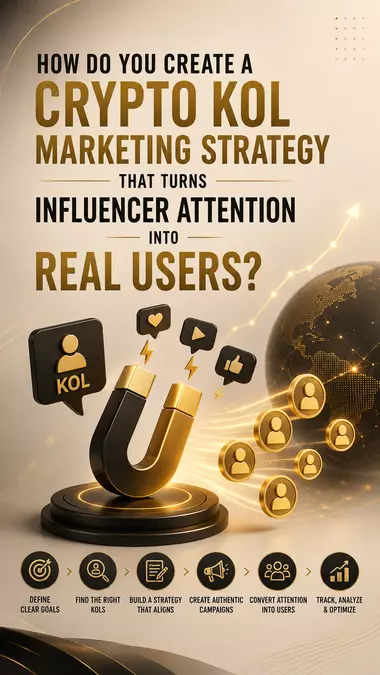
Getting a crypto KOL to talk about your project is easy compared with getting their audience to actually use your product.
A post can generate thousands of views, hundreds of likes, and plenty of comments. But if those people never visit your website, join your community, try the product, or become users, the campaign has limited business value.
This is why effective crypto KOL marketing should not be measured only by impressions.
The real question is:
Can influencer attention turn into meaningful user activity?
To achieve that, Web3 projects need to build a campaign around the entire journey from attention to action.
A conversion-focused KOL strategy connects influencer content to a measurable user journey.
Instead of:
KOL post → likes → campaign ends
the process should look more like:
KOL content → click → landing page → community/product → activation → retention
Every stage has a purpose.
The KOL creates attention, the landing page explains the value, the product delivers the experience, and the analytics show where users are dropping off.
Before hiring influencers, decide what conversion actually means for your project.
A conversion could be:
Don't simply tell your KOL:
"Drive users."
Give them a specific action.
For example:
"Drive qualified users to register for the testnet."
That makes the campaign much easier to plan and measure.
Not every large crypto influencer can generate users.
A KOL may have hundreds of thousands of followers but an audience that isn't interested in your product.
Instead, evaluate:
Does their audience match your target users?
Do people genuinely interact with their content?
Can they naturally explain your product?
Have previous campaigns generated clicks or conversions?
Are their followers located in your target markets?
A smaller KOL with a highly relevant audience can sometimes outperform a much larger general crypto account.
Instead of putting your entire budget into one influencer, consider building a portfolio.
For example:
Tier 1 — Large KOLs
Used primarily for awareness.
Tier 2 — Mid-Tier KOLs
Used for awareness plus engagement.
Tier 3 — Micro-KOLs
Used for niche audiences and conversions.
Specialist KOLs
Used for technical education, DeFi analysis, trading, gaming, AI, or another specific category.
This creates multiple paths into your campaign.
This is one of the simplest ways to understand campaign performance.
Give every creator a unique URL.
For example:
project.com/join?ref=kol01
Another creator might receive:
project.com/join?ref=kol02
Now you can track exactly where traffic and conversions came from.
You can measure:
Without tracking, you are essentially guessing.
This is a surprisingly common mistake.
A KOL talks about your project and sends users to the homepage.
The visitor arrives and sees:
They may have no idea what to do next.
Instead, create a campaign-specific landing page.
For example:
"Explore the New DeFi Protocol"
The page should immediately explain:
The fewer unnecessary steps, the better.
The experience should feel connected.
Suppose the KOL says:
"I've been testing this new trading platform. If you want to try it yourself, you can register here."
The landing page should continue that story.
It shouldn't suddenly become:
"Welcome to the future of decentralized financial infrastructure."
The message needs continuity.
KOL content → landing page → product
The user should feel like they are continuing the same journey.
Attention doesn't automatically create action.
There needs to be a clear reason for users to continue.
Depending on the project, this could be:
The incentive doesn't always need to be financial.
Sometimes access, information, or participation is enough.
For product-led campaigns, screenshots and demonstrations can be more powerful than generic promotional posts.
Instead of:
"This project has an exciting new platform."
A creator could show:
This reduces the gap between hearing about a product and understanding how to use it.
Once you have conversion data, calculate CPA.
CPA = Total KOL Campaign Cost ÷ Number of Conversions
For example:
Campaign cost = $5,000
New users = 500
CPA = $10
Now compare different KOLs.
| KOL | Cost | Users | CPA |
| KOL A | $2,000 | 100 | $20 |
| KOL B | $1,500 | 250 | $6 |
| KOL C | $1,000 | 50 | $20 |
KOL B is clearly more efficient from an acquisition perspective.
This is why campaign-level measurement is more useful than simply ranking influencers by follower count.
If a creator consistently produces qualified users, don't treat them as a one-off placement.
Consider building a longer relationship.
They might become:
Long-term partnerships can also make the content feel more natural because the creator becomes genuinely familiar with the product.
A successful crypto KOL campaign doesn't end when an influencer publishes a post.
That's where the user journey begins.
The strongest campaigns connect https://www.inoru.com/kol-marketing-agency how a Web3 project approaches influencer marketing.
The goal isn't to buy attention.
It's to turn attention into action, action into users, and users into long-term participants in the ecosystem.


Comment