
Alerts
-
5 minutes, 7 seconds
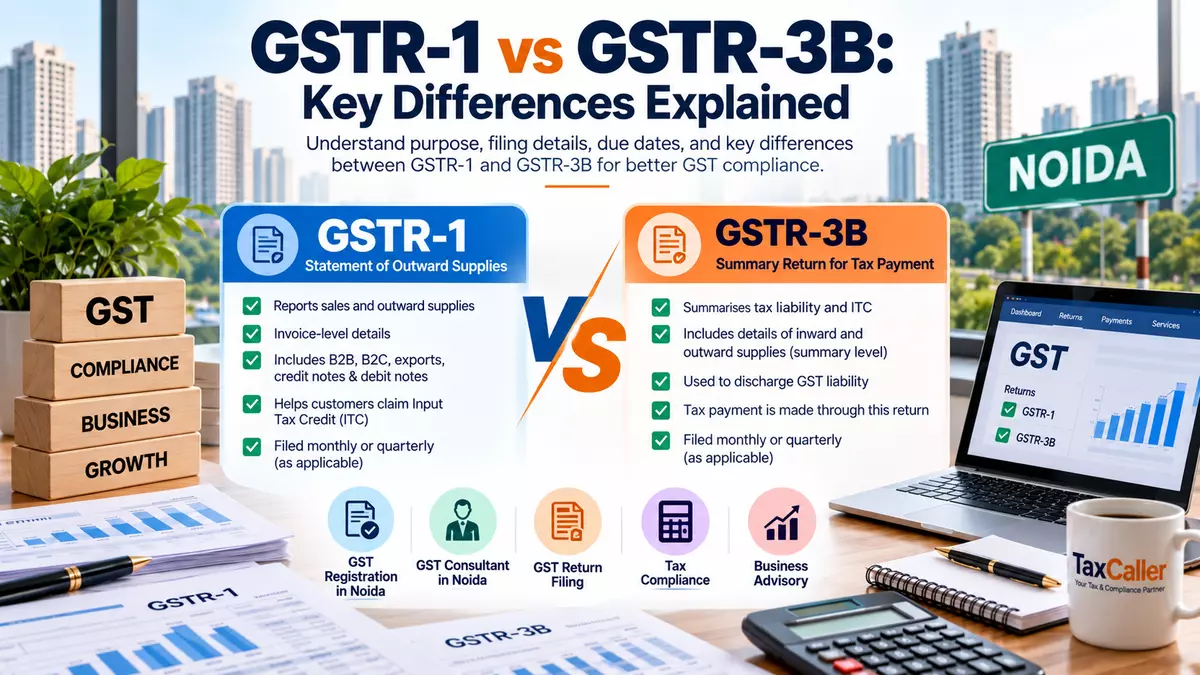
It is important for businesses registered under the Goods and Services Tax (GST) regime in India to know their return filing responsibilities to stay compliant and avoid unnecessary mistakes. There are two main GST returns – GSTR-1 & GSRT-3B. Both are related to a business’s GST liability but they serve different purposes and require different information.
It is important for business owners to know the difference between GSTR-1 and GSTR-3B so that they can maintain proper records, report sales properly and pay the right amount of tax. This guide explains their main differences, filing process, deadlines and common mistakes.
GSTR-1 is a statement of outward supplies, which contains details of sales of goods and services made during a particular tax period. Regular taxpayers are generally required to report invoice level information for the applicable business to business transactions, relevant business to consumer supplies, exports, credit notes, debit notes and other prescribed details.
Information provided in GSTR-1 helps customers and the GST system in processing relevant transaction information for the purposes of return reporting and for claiming input tax credit.
GSTR-1 can be generated by businesses based on their sales invoices, credit notes, debit notes and other supporting records. Accuracy is very important because mistakes will affect the customer’s records and will need to be corrected later.
GSTR-1 is applicable to regular and casual taxpayers who are required to report their outward supplies, with a few exceptions, as per the advice of the GST Portal.
GSTR-3B is a summary return, filed by the eligible taxpayers declaring their GST liabilities, eligible input tax credit (ITC) and such other requisite information for a tax period. It is also used to determine the tax liability after considering eligible credits and applicable adjustments.
Typically, before filing GSTR-3B, businesses review their outward supplies, reverse-charge liabilities (where applicable), eligible ITC and tax payments.
GSTR-3B is not like GSTR-1, which mainly provides details of outward supplies. It is about reporting tax liability and credit information and fulfilling the process of tax payment.
Taxpayers should not take auto-populated figures at face value. Before filing, they have to cross check the information with their books, invoices and GST records, if any.
| Basis | GSTR-1 | GSTR-3B |
|---|---|---|
| Main purpose | Reports details of outward supplies | Summarises tax liability and eligible ITC |
| Information | Sales invoices, credit notes, debit notes, exports, and other outward supply details | Summary of supplies, tax liability, ITC, and tax payment details |
| Tax payment | Does not itself discharge the period's tax liability | Used to discharge the reported tax liability |
| Customer information | Includes applicable invoice-level recipient details | Primarily contains summary-level information |
| Filing frequency | Monthly or quarterly, depending on eligibility and scheme | Monthly or quarterly, depending on eligibility and scheme |
| Relationship | Provides outward supply information used in GST reporting | Uses relevant reported information to help determine and discharge tax liability |
| Common errors | Missing invoices, incorrect GSTINs, or wrong invoice values | Incorrect tax liability, ITC, or payment calculations |
The precise requirements depend on the taxpayer category and applicable GST rules.
For many regular taxpayers, the general due dates are:
These are general timelines, not universal deadlines. Different taxpayer categories may have different requirements, and government notifications may extend due dates. Always check the GST Portal for the applicable tax period.
GSTR-1 and GSTR-3B is prepared on uniform and precise financial records. The outwards supply figures and tax liability declared in GSTR-3B need to be matched with the sales declared in GSTR-1.
If a business declares ₹5,00,000 as taxable sales in GSTR-1, it needs to ensure that the relevant taxable value and tax liability is correctly declared in its GSTR-3B after making applicable adjustments.
Variations can be caused by missed invoices, amendments, credit notes, timing differences or reporting errors. These discrepancies should be investigated and rectified under the prescribed GST procedure.
According to the GST Portal guidance, it is also mandatory to file GSTR-1 before GSTR-3B for the same tax period under the applicable filing process.
Businesses should watch out for these frequent errors:
Maintaining updated books, reviewing invoices, and reconciling returns before submission can help reduce these risks.
As a business expands, gains new customers or increases the number of transactions, GST compliance can get more complicated. Professional help can be useful in helping businesses organize records, prepare returns, reconcile sales and identify reporting anomalies.
Businesses who take GST Registration in Noida may also require continuous support with GST return filing and compliance post registration.
A GST Consultant in Noida can help to review the GSTR-1 and GSTR-3B data, explain the filing requirements and guide the business through the applicable correction processes. TaxCaller offers services like GST registration, GST return filing and other tax related consultancy services to the businesses and entrepreneurs.
GSTR-1 and GSTR-3B are meant to serve different but interlinked purposes. GSTR-1 contains details of outward supplies whereas GSTR-3B contains a summary of tax liability and the ITC that can be availed and helps in making tax payments.
Businesses should compare both returns against their own accounting records, check data auto-populated and file within the relevant deadlines. TaxCaller can help you with GST Consultant in Noida and ongoing compliance, help you understand your GST filing responsibilities and keep your tax records organized.




Comment