
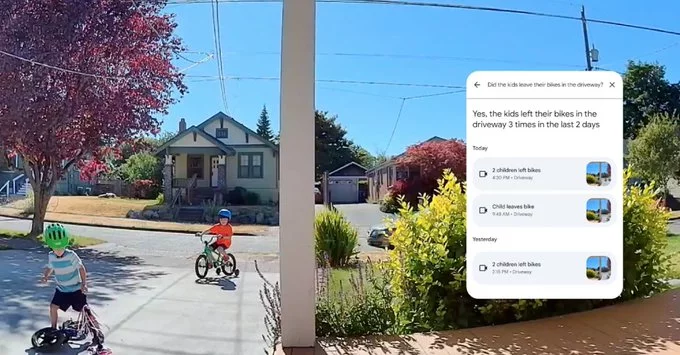
Smart home users have been asking a simple question for years: can Google Home actually see what my cameras see right now? With the new Google Home Live Search feature powered by Google Home and Gemini, the answer is finally yes. Instead of only analyzing recorded footage, Gemini can now describe live camera feeds in real time. That means you can ask, “Is there a car in the driveway?” or “Is Liam wearing his helmet?” and get instant AI-powered responses.
This update marks one of the biggest upgrades to Google’s smart home platform in years.
Google Home Live Search: What It Actually Does
At the center of this update is Live Search, a feature that allows Gemini to interpret and describe what your connected cameras are seeing at that exact moment.
Previously, Google Home could summarize past events—like motion alerts or detected packages. Now, it processes live video feeds and responds conversationally. If someone is standing at your front door, you can ask your smart speaker or phone what’s happening without opening the camera app.
This real-time understanding transforms Google Home from a passive alert system into an active AI assistant. Instead of scrolling through clips, users can simply ask questions in natural language.
Gemini’s New Models Improve Accuracy and Context
Alongside Live Search, Gemini for Home is running on updated AI models. Google says this improves answer quality, contextual understanding, and even general knowledge responses.
For example, when you say, “Turn off the kitchen,” Google Home now understands you likely mean the lights—not every smart device in the room. That nuance has been a long-standing frustration for users managing multiple connected gadgets.
Even broader commands are getting smarter. If you say, “Turn off all the lights,” the system will now apply that instruction to your current location instead of switching off lights at a secondary property you manage. For families with multiple homes linked under one account, this is a meaningful fix.
Subscription Details: What It Costs
There is a catch. Live Search requires the Advanced tier of Google Home Premium.
The Advanced plan costs $20 per month or $200 per year. While Google continues to offer basic smart home controls for free, advanced AI-powered features like live video interpretation are clearly being positioned as premium capabilities.
For users already paying for cloud video storage and smart alerts, the added AI intelligence may justify the cost. For others, this could spark debate about whether real-time AI descriptions should be locked behind a subscription.
Why Live Camera AI Is a Big Deal for Smart Homes
Real-time camera understanding represents a shift in how smart homes function. Instead of pushing alerts and waiting for you to react, the system becomes conversational and proactive.
Parents can quickly check on children playing outside. Homeowners can confirm whether deliveries have arrived. Pet owners can ask what their dog is doing without scrubbing through timelines.
The difference is subtle but powerful: you’re no longer navigating footage—you’re having a dialogue with your home.
Fixing Long-Standing Google Home Frustrations
Beyond Live Search, this update addresses several smaller annoyances that have lingered for years.
Device targeting is more precise. Context recognition is stronger. General queries should produce more accurate responses. Even music playback commands benefit from improved understanding of newly released tracks.
These refinements may not grab headlines like Live Search does, but they significantly enhance day-to-day usability. Smart home ecosystems thrive on reliability, and incremental improvements often matter more than flashy features.
Privacy and Trust in AI-Powered Cameras
Whenever live AI analysis is introduced, privacy concerns naturally follow.
Google emphasizes that Live Search works within its existing security and account protections. Still, users should carefully review camera placement, access permissions, and subscription settings before enabling real-time AI descriptions.
Smart home technology continues to walk a delicate line between convenience and surveillance. As AI becomes more capable, transparency and control will remain critical for maintaining user trust.
How Google Home Live Search Changes the Competition
With Live Search, Google is signaling that AI is no longer just an add-on to smart homes—it’s becoming the foundation.
Competitors have introduced smart detection features, but conversational, real-time camera interpretation raises the bar. Instead of receiving generic alerts like “motion detected,” users can ask specific, context-driven questions and get meaningful answers.
This evolution aligns with Google’s broader AI strategy: embedding Gemini deeply into everyday products rather than keeping it as a standalone chatbot.
A Smarter, More Conversational Home
Google Home Live Search is more than a feature update—it’s a preview of how AI assistants may function going forward.
Smart homes are shifting from automation hubs to intelligent companions capable of understanding context, interpreting visuals, and responding naturally. The ability to ask, “Is there someone in the driveway?” and receive a clear answer feels less like sci-fi and more like the next logical step.
For users invested in the Google ecosystem, this update delivers long-awaited refinements alongside a genuinely futuristic capability. Whether the subscription price feels justified will depend on how often you rely on real-time camera insights.
One thing is clear: your smart home can now see—and describe—what’s happening in the moment.










Comment