Alerts

-
3 minutes, 57 seconds
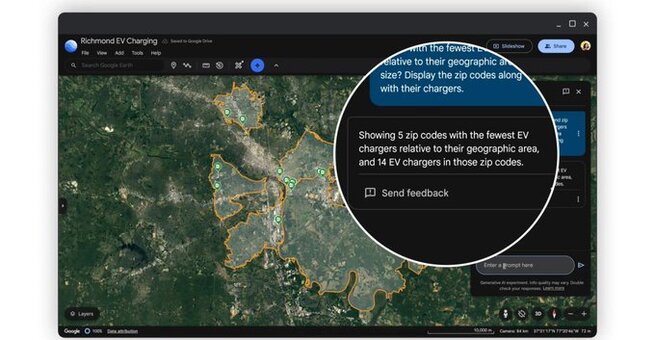
Google Earth is taking exploration to a whole new level. With Google Earth’s expanded AI features, users can now ask complex questions directly and receive intelligent, data-rich answers powered by Gemini. Whether you’re searching for weather patterns, environmental risks, or urban growth trends, this AI-driven update transforms how people interact with Earth’s data.
The latest update integrates Gemini, Google’s multimodal AI, into Earth’s Geospatial Reasoning framework. This means users can chat naturally with Google Earth AI to analyze satellite imagery, weather forecasts, and population data — all in one place. For example, you could ask it to identify areas vulnerable to flooding or detect communities at risk during a drought.
This integration connects multiple AI models, making responses more accurate and context-aware. It’s part of Google’s continued investment in merging environmental intelligence with human-centered design.
Google is making its tools feel more conversational and approachable. Trusted testers can now use chat-based features in Google Earth to find objects, patterns, and anomalies in satellite images. Simply asking, “Show me where algae blooms are forming” could return dynamic maps and real-time analysis.
By expanding AI features, Google Earth helps professionals and researchers visualize complex environmental challenges in seconds. It’s a shift from static maps to an interactive AI assistant that understands the planet.
US-based users with Google Earth Pro and Ultra subscriptions will soon gain access to these enhanced Gemini-powered tools. These upgrades allow for greater query limits and more detailed AI responses. Businesses, scientists, and policymakers can also merge their proprietary datasets with Google’s geospatial AI models to get deeper insights on population, environment, and climate trends.
Google confirmed that these features are being rolled out first to its trusted tester community before wider availability in the coming weeks.
With Google Earth’s expanded AI features, the platform evolves beyond visualization. It becomes a collaborative space where human curiosity meets powerful computation. From monitoring drinking water quality to assessing wildfire risks, this update turns Google Earth into an intelligent global observatory that anyone can converse with.
This is more than just a new feature — it’s a glimpse into the future of AI-driven exploration. By blending geospatial data with Gemini’s reasoning capabilities, Google Earth positions itself as a vital tool for environmental planning, disaster prevention, and sustainability research.
Whether you’re an environmentalist, a journalist, or just curious about our planet, Google Earth’s expanded AI features make it easier to ask it questions — and to get the answers that matter.










Comment