Alerts

-
6 minutes, 43 seconds
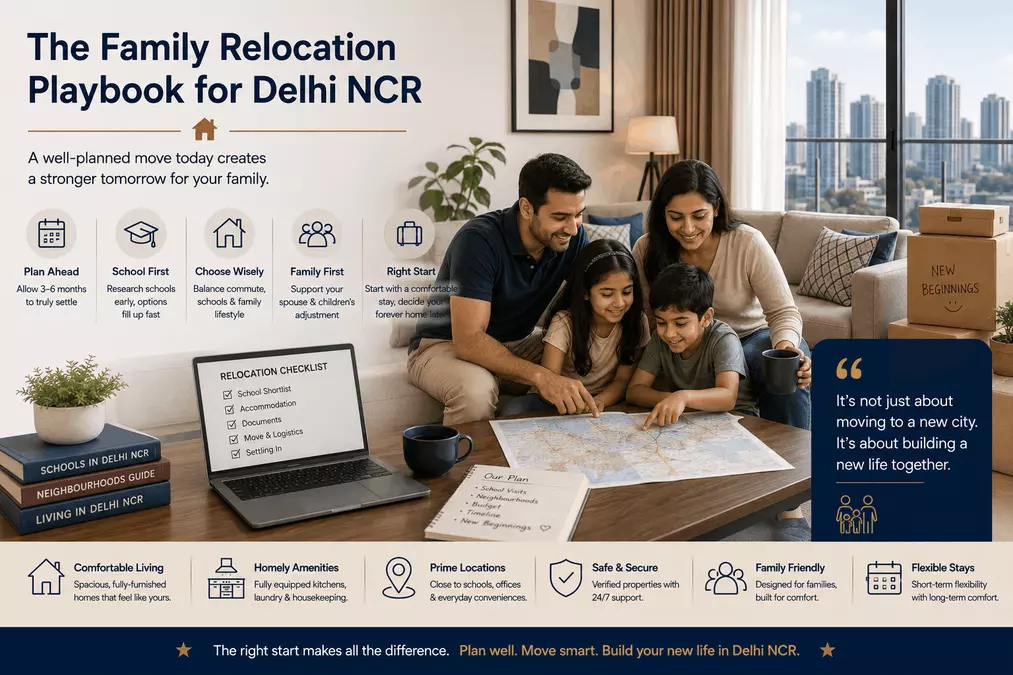
Relocating to Delhi NCR for a significant professional posting is one thing when you're moving alone. It's an entirely different undertaking when the move involves a partner, children, and the full ecosystem of a family's daily life. The professional challenge of starting a demanding new role — new team, new stakeholders, new performance expectations — runs simultaneously with the family logistics of school admissions, housing transitions, spouse career disruption, and the adjustment process that every family member goes through when the familiar context of a previous city is suddenly gone.
Most relocation planning focuses on the professional side. The accommodation, the office commute, the logistics of the move itself. The family side of the equation — which is often larger, more emotionally complex, and more consequential for the family's long-term wellbeing in the new city — receives less systematic attention. This guide is for families for whom Delhi NCR is the next chapter, and who want to approach the transition with more structure than instinct alone provides.
Family relocations to Delhi NCR rarely go as quickly as the professional would prefer. The wishful version — move in January, children in school by February, settled by March — consistently collides with the realities of school admission timelines, lease agreements for permanent housing, and the adjustment period that children and partners require.
The practical timeline for a well-managed family relocation to Delhi NCR typically spans three to six months from initial arrival to genuine settled stability. This includes the school research and admission process, the search for permanent housing in a location that works for both the professional's commute and the family's school and daily life requirements, and the social establishment process that makes a new city feel like home rather than a temporary disruption.
Understanding this timeline before arriving means planning accommodation for the transition period rather than expecting to move directly into a permanent situation. Families that arrive expecting to find permanent housing within the first two weeks consistently spend the first month in inadequate temporary arrangements while scrambling through an unfamiliar housing market under time pressure.
School admission in Delhi NCR, particularly for well-regarded schools, involves waiting lists, specific documentation requirements, and admission timelines that operate on the school's calendar rather than the family's. For families arriving mid-academic year — which most corporate and government postings involve — the options are more constrained than during the standard admission season.
The school research should begin before the family leaves the previous city. Delhi and Noida both have significant school infrastructure across CBSE, ICSE, and international curriculum options. The school decision interacts directly with the accommodation location decision — the best school for a particular child's educational needs may not be in the same neighbourhood that the professional's commute logic suggests as the ideal base.
This interaction between school location and accommodation location is the source of most family relocation accommodation regret in Delhi NCR. Families that choose accommodation based only on the professional's commute, without factoring in school proximity, often find themselves managing a school commute for children that is as logistically demanding as the professional commute — except that it occurs twice daily and involves children rather than adults capable of managing their own transit.
The most practical approach for families relocating to Delhi NCR is a two-stage accommodation strategy — transition accommodation for the arrival and settling-in period, followed by a permanent arrangement once the school and housing decisions can be made with knowledge of the city rather than assumptions about it.
Stage one is the arrival and research phase — typically two to four months. The family needs somewhere that is fully functional from day one, that provides adequate space for normal family life, and that is located in a part of the NCR that allows the family to explore their school and neighbourhood options from a workable base without committing to any of them prematurely.
Serviced apartments are the format that works for stage one. For families arriving in Delhi, exploring luxury serviced apartments in new delhi in South Delhi's established family residential areas provides access to the residential infrastructure, school proximity, and neighbourhood character that makes the research phase manageable. The furnished, kitchen-equipped, professionally managed format eliminates the setup burden from a period when the family's bandwidth is already consumed by the school research, the professional's new role demands, and the adjustment process.
For families whose professional anchor is in Noida — technology companies, IT campuses, digital and media organisations — Noida's residential infrastructure has developed sufficiently to serve family relocation needs that previous decades of Noida residential development didn't address as well.
The city's premium residential corridors — DLF My Pad, Sector 50, the Expressway-adjacent developments — provide family-appropriate accommodation quality alongside the school options that have followed Noida's growing professional population. International and premium CBSE schools have established campuses in and around Noida that provide educational quality comparable to Delhi's established school zones for families whose professional anchor is in the eastern NCR rather than central Delhi.
For these families, the two-stage relocation strategy applies as clearly as for Delhi-anchored moves. Exploring serviced apartments in noida in well-established family residential sectors provides the transition-phase accommodation from which school research, neighbourhood assessment, and permanent housing search can be conducted without the pressure of having committed prematurely to a location that may not suit the family's full set of requirements.
The spouse's transition is frequently the most under-planned aspect of family relocations to Delhi NCR, and it's consistently the transition that most affects long-term family wellbeing in the new city.
A spouse who had an established professional career in the previous city faces the particular challenge of rebuilding that professional context in a new market — re-establishing client relationships, navigating a new professional network, and in some cases managing a career interruption whose duration is uncertain.
Delhi NCR's professional ecosystem is large enough and diverse enough to support most career paths, but the access to that ecosystem depends on the social and professional networks that take time to build. The neighbourhood where the family settles affects access to these networks — established residential areas with active professional communities provide more natural networking infrastructure than newer developments where residents themselves are still building community.
The transition accommodation location affects this too. A family in a well-located serviced apartment in a neighbourhood with an active residential community reaches the social network building phase faster than one in an isolated development where neighbours are also in transition and community infrastructure is minimal.
Adopremium has developed its Delhi and Noida portfolio with family relocation occupancy as one of the primary resident profiles — apartments with adequate bedroom separation, fully equipped kitchens that support family meal preparation, and location quality that serves both professional commute access and family daily life requirements. The management standard that holds up across the multi-month transition period is the quality commitment that distinguishes genuinely family-appropriate serviced accommodation from hotel-style units marketed as family-friendly.
Senior professionals whose families settle well in Delhi NCR consistently perform better in their postings than those whose family transition extends into a prolonged period of domestic disruption. The professional who can focus on the work from the third month because the family is settled — schools found, partner reestablishing professional life, children adjusted — is operating from a different foundation than one still managing accommodation transitions and family logistics six months into a demanding new role.
The family relocation deserves the same planning rigour as the professional relocation. It's the dimension of the move that most affects whether the posting, and the family, thrives in Delhi NCR.





Comment