Alerts

-
7 minutes, 11 seconds
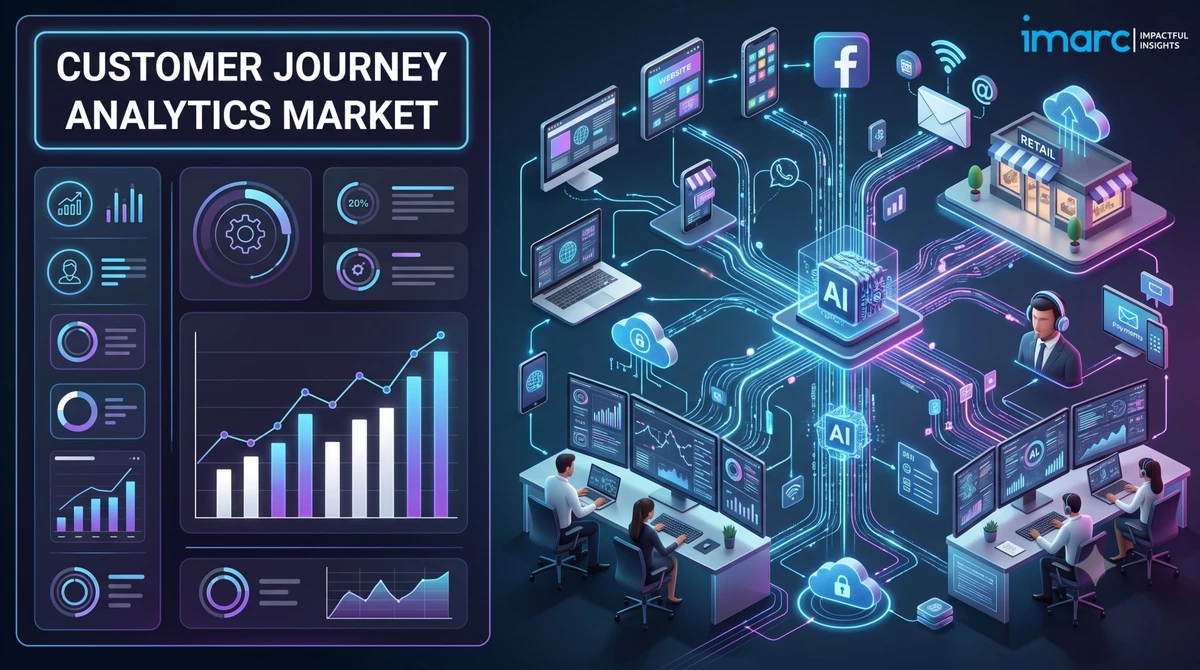
The global customer journey analytics market size reached USD 17.3 Billion in 2025. Looking forward, the market is expected to reach USD 56.5 Billion by 2034, exhibiting a growth rate (CAGR) of 13.65% during 2026-2034, reflecting the growing urgency among enterprises to convert scattered customer interactions into a single, actionable view. North America leads the market, driven by an intensifying focus on personalized customer experiences and a broader shift toward omnichannel analytics. Rising volumes of real-time data from connected devices and applications, combined with the push to enhance virtual touchpoints, continue to reshape how businesses understand and act on customer behavior.
Grab a sample copy of this report: https://www.imarcgroup.com/customer-journey-analytics-market/requestsample
Customer journey analytics refers to the practice of tracking and analyzing every interaction a customer has with a brand, across channels such as web, mobile, email, social media, call centers, and physical branches, to build a unified, end-to-end view of behavior. Businesses use these insights to personalize engagement, predict churn, and streamline operations. As digital and physical touchpoints multiply, the challenge of stitching together a cohesive customer profile from disparate data sources is pushing companies toward more sophisticated, AI-driven analytics platforms.
The adoption of AI continues to be the single biggest force reshaping this market. Machine learning and AI are enabling businesses to process vast amounts of interaction data efficiently, uncovering patterns that would otherwise stay hidden across siloed systems. Fullcast's acquisition of Datajoin to unify customer journey analytics reflects a broader consolidation trend, as go-to-market platforms move to close data gaps that have historically limited the accuracy of journey mapping.
Omnichannel integration is another major driver, as consumers now move fluidly between in-store, mobile, online, and social touchpoints. Retailers have expanded omnichannel capabilities across multiple business segments to let customers shop seamlessly across formats, while niche integrations, such as combining order management systems directly with e-commerce platforms, are making it easier for mid-sized brands to deliver a consistent experience. Starbucks remains a widely cited example of this shift, using its mobile app to unify in-store and digital experiences while capturing valuable data to sharpen marketing and service delivery.
Demand for real-time analytics is rising just as fast. Native journey management capabilities are now being built directly into cloud contact center platforms, letting organizations continuously optimize every customer interaction as it happens rather than after the fact. This mirrors patterns seen in other real-time-dependent industries, where matching supply with demand instantly has become a competitive necessity, and it is pushing customer experience teams to treat real-time responsiveness as a baseline expectation rather than a differentiator.
Some of the prominent companies in the global market include:
By Component: Solution, Services
Solutions currently dominate this segment, driven by rising demand for AI-driven analytics tools capable of processing vast volumes of customer data. Platforms such as Salesforce's Einstein Analytics use AI to deliver predictive insights that help businesses personalize marketing, while Adobe Experience Cloud analyzes journeys across multiple touchpoints to support more effective campaigns. These AI-driven solutions are automating data analysis while giving teams real-time visibility into shifting customer needs.
By Touchpoint: Web, Social Media, Mobile, Email, Branch and Store, Call Center, Others
Email holds the largest share here, owing to its role as a direct, personalized channel for targeted marketing, feedback collection, and service notifications. Businesses track engagement metrics like open rates and click-throughs to understand behavior and preferences, with personalized email campaigns based on purchase history and browsing patterns proving especially effective at driving both sales and engagement.
By Deployment: On-premises, Cloud-based
On-premises deployment leads the segment, particularly among industries such as finance and healthcare that face strict data privacy requirements. On-premises solutions let organizations manage sensitive interaction data within their own infrastructure while still gaining deep behavioral insights, giving them full control over compliance and security without sacrificing analytical depth.
By Organization Size: Large Enterprises, Small and Medium-sized Enterprises
Large enterprises rely on customer journey analytics to manage complex, high-volume interactions across many channels, while small and medium-sized enterprises turn to scalable, cost-effective solutions to refine strategy and boost engagement without the overhead of enterprise-grade infrastructure.
By Application: Customer Segmentation and Targeting, Customer Behavioral Analysis, Customer Churn Analysis, Brand Management, Campaign Management, Product Management, Others
Campaign management commands the largest share, given its central role in planning, executing, and tracking marketing efforts across channels. Brands use journey analytics to analyze engagement data from social media, email, and in-store interactions, sharpening the precision of promotional campaigns and directly boosting conversion rates and loyalty.
By Industry Vertical: BFSI, IT and Telecommunications, Retail and E-Commerce, Healthcare, Media and Entertainment, Travel and Hospitality, Others
BFSI leads this segment, given the complexity of customer interactions across account setup, transactions, and support. Financial institutions use analytics to streamline these processes and personalize policy recommendations, while insurers apply the same insights to build more customer-centric product offerings and proactive support models.
North America dominates the market, supported by advanced technological infrastructure and high rates of digital transformation adoption. Leading retailers use journey analytics to track interactions across online and offline channels, while banks apply the same insights to tailor financial products and deliver more personalized service.
Asia Pacific continues to see fast-growing adoption as regional enterprises invest in cloud and AI infrastructure to support real-time customer analytics. Rising digital commerce activity across the region's major markets is pushing more businesses to adopt journey analytics for both acquisition and retention.
Europe is seeing steady adoption, particularly in sectors requiring strict compliance around data handling, with organizations leaning on unified analytics to strengthen customer engagement while meeting regulatory obligations.
Latin America is following the region's broader e-commerce boom, with a sizable base of digital buyers prompting brands to invest more heavily in journey analytics to understand cross-channel behavior and lift conversion rates.
Middle East and Africa are showing rising interest as digital and telecom services expand, with businesses turning to journey analytics to improve customer experience amid rapidly growing digital engagement.
The customer journey analytics market remains highly competitive, with established software giants and specialized analytics vendors both vying for share. Differentiation increasingly comes down to AI capability, particularly around predictive behavior modeling, automated feedback analysis, and real-time journey orchestration. Vendors are investing heavily in expanding integrations across CRM, e-commerce, and contact center ecosystems, while smaller, more focused players are gaining traction through acquisitions that fill specific data-unification gaps. Pricing pressure and platform consolidation are pushing vendors to bundle broader customer experience capabilities rather than compete purely on journey mapping alone.
This overview reflects select highlights from IMARC Group's full market research report. The complete study includes deeper segment-level breakdowns, country-level analysis, and detailed competitive profiling, and can be tailored to specific business or research requirements.
IMARC Group is a leading market research company dedicated to providing data-driven insights and expert consulting services to support businesses in achieving their strategic objectives across diverse industries.
Email: [email protected]
United States: +1-201-971-6302
United Kingdom: +44-753-714-6104
India: +91-120-433-0800




Comment