
Alerts
-
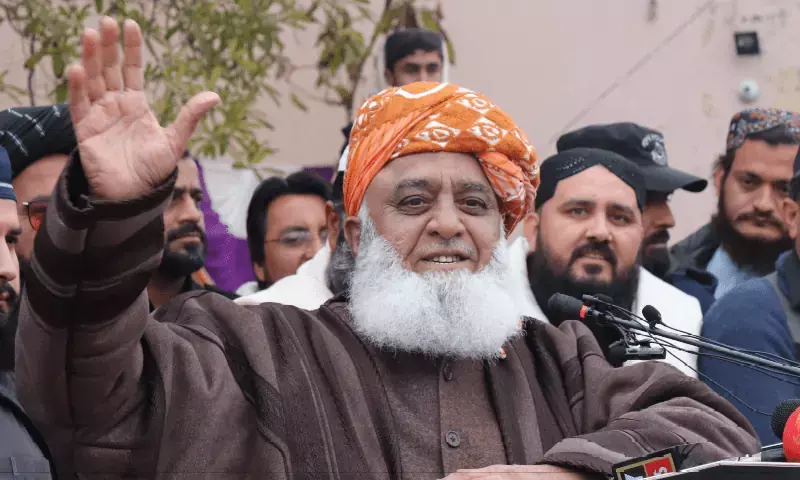
ISLAMABAD: With both the government and the main opposition PTI knocking on his door, Maulana Fazlur Rehman is once again being cast as the man who can defuse a potential confrontation between the two sides. But the question is: what leverage does the veteran politician actually have to bring them to the table? Going by the numbers, somewhat less than he once did. His JUI-F holds just 10 seats in the National Assembly, 18 in Khyber Pakhtunkhwa and 12 in Balochistan Assembly. In KP, it sits in opposition to a PTI government, and in Balochistan too it is on the opposition benches. Its seven members in the Senate, however, still make it a force to be reckoned with in the upper house. This arithmetic has led some observers to believe that, as the Maulana has neither a direct role nor significant representation in the two provincial governments, he is in no position to pressure the government and PTI. While some feel that he lacks the parliamentary numbers to exercise any real influence over either side, the Maulana has proven himself time and again to be an expert in the ‘art of the possible’ PM Shehbaz Sharif’s Adviser on Political Affairs, Rana Sanaullah, has already ruled out the possibility that the JUI-F chief could bring political temperatures down. “We have met Maulana Fazlur Rehman but he did not give assurance that he will bring both sides [the government and the PTI] on table for dialogue,” he said. In addition, Parliamentary Affairs Minister Tariq Fazal Chaudhry recently claimed that PTI ranks seemed divided on the Maulana’s intervention, and therefore may not accept whatever the JUI-F chief suggests. PTI’s Khyber Pakhtunkhwa president Junaid Akbar, however, said on Thursday that the party had authorised the JUI-F chief to “mediate”, though he was quick to add that the Maulana had so far not conveyed any government offer. Some believe both sides are looking for face-saving: the PTI does not actually want to take its protest march to Islamabad, and the government does not want another bloody clash in the federal capital. Pakistan Institute of Legislative Development and Transparency (Pildat) President Ahmed Bilal Mehboob, however, said if anyone can bring both sides to the table, it is the Maulana, as he is a rare breed of politician. He said both sides wanted face-saving in the current fragile political situation and would definitely look to resume dialogue. In fact, PTI leaders have demanded a meeting with the party’s incarcerated founder Imran Khan in jail, while the government has asked the PTI to call off its long march [which is still being staged in KP]. “I think the Maulana can find a middle way in this situation,” he added. In what capacity? So what exactly is the Maulana’s role right now? Talking to Dawn, JUI-F spokesman Aslam Ghauri said his party chief was playing the role of a “facilitator, not a mediator”. He distinguished the two roles by saying that a mediator would have the authority from opposition parties to make his own decision in the light of their demands. “It is our [JUI-F’s] priority to bring both sides on table for resumption of talks,” he added. Mr Ghauri also pointed out that they had urged the government to call a multi-party conference in Parliament House, where political and security issues should be discussed. The JUI-F leader said sitting on the table would benefit both sides. “Resumption of dialogue will mostly benefit PTI because the KP government is virtually being run by someone else and not by Chief Minister Sohail Afridi. On whose orders was section 144 imposed in Abbottabad and the deputy commissioner Peshawar placed containers on roads to block the PTI long march?” While media reports suggested that PM Shehbaz may soon consult the JUI-F chief, the party spokesman told Dawn they had so far not received any such indication from PM Office. Interestingly, PTI leader Shaukat Yousufzai recently claimed during a talk show that the Maulana had already played a role, and that it was on his suggestion that the PTI changed the date of its long march from Sept 27 to Oct 4. This assertion, however, was subsequently denied by PTI’s Asad Qaiser. Political muscle While he may not command the same political clout that he once did, the Maulana is still a force to be reckoned with. Let’s not forget that he was the leader of the Pakistan Democratic Movement (PDM) alliance that unseated the Imran Khan-led PTI government in 2022. Just a few years earlier, he had brought a mass of khaki-clad protesters to the capital and kept them camped there for nearly a fortnight in 2019 to demand Imran’s resignation. It wasn’t too long ago, either, that the government was forced to seek his support when it was putting together the 26th Constitutional Amendment. At the time, the JUI-F’s eight votes, along with six from independents and PTI-backed members, proved instrumental in getting the amendment passed, while its five senators proved similarly decisive in the upper house. Subsequently, though, the passage of the 27th Amendment indicated the waning of his parliamentary clout. After the Supreme Court’s 2025 verdict on reserved seats, the Election Commission of Pakistan restored seats to the PML-N, PPP and JUI-F, and the ruling alliance’s National Assembly strength rose to over 230, clear of the two-thirds mark. When the Maulana announced in Nov 2025 that his party would not vote for the 27th Amendment, the government was already reported to have the backing of 65 senators in the 96-member house, even without JUI-F’s seven. Published in Dawn, October 10th, 2026






Comment