Alerts

-
3 minutes, 7 seconds
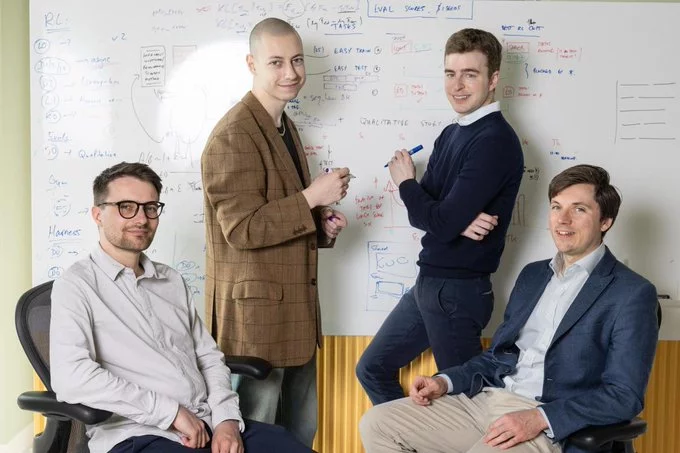
Faraday is an AI agent developed by Inherent, a British AI lab founded by DeepMind alumni. Its primary capability is the ability to replicate scientific papers—meaning it can take an existing research paper and reproduce its experiments, data, and findings. Rather than simply summarizing or paraphrasing text, Faraday is designed to execute the underlying scientific work, acting as an autonomous research assistant that can re-run analyses and generate results that match the original publication.
This positions Faraday as a tool for verification and acceleration. For researchers, it could help confirm the reproducibility of published results or quickly generate analogous datasets for new studies. By focusing on the concrete output of a paper—not just its narrative—Faraday aims to bridge the gap between reading a study and actively engaging with its methodology. Inherent positions this as a step toward more reliable and efficient scientific workflows, where AI handles the repetitive, computational aspects of research replication.
Faraday is designed to reproduce the experiments and results described in scientific papers. Rather than treating a publication as a static record, the platform treats it as a starting point for active inquiry. By systematically recreating the conditions, methodologies, and data analyses outlined in a study, Faraday enables researchers to verify findings and explore their boundaries.
This approach serves as a stepping stone for innovation. When an experiment is faithfully reproduced, the underlying assumptions become clearer, and the path to extending the work becomes more tangible. Researchers can build on a validated foundation, testing new variables or combining results with other studies. The core function is not just replication for its own sake, but the creation of a reliable base from which novel ideas can emerge. In this way, Faraday helps bridge the gap between reading a paper and advancing its original contributions.
Faraday’s ability to replicate papers could dramatically accelerate the pace of scientific progress. By generating working code from a paper’s description, it enables faster verification of results, allowing researchers to confirm findings without manually reimplementing complex methods. This reduces the time spent on tedious reproduction, freeing scientists to focus on novel hypotheses.
Moreover, Faraday supports building on existing work more efficiently. Researchers can take a replicated baseline and immediately extend it, testing new variations or integrating it into larger systems. This lowers the barrier to entry for interdisciplinary teams who may lack deep expertise in a specific codebase.
While human oversight remains essential for interpreting results, Faraday’s role as a research assistant could shorten the cycle from idea to validated finding, accelerating cumulative science.
Inherent was founded by a team of DeepMind alumni, a pedigree that signals a deep, first-hand expertise in cutting-edge artificial intelligence. This background is not incidental; it is the core of the company’s identity and approach. The founders’ experience at one of the world’s leading AI labs informs their ambitious mission: to push the boundaries of AI-driven science. Rather than applying AI incrementally, Inherent aims to fundamentally accelerate the pace of scientific discovery by building advanced AI systems that can tackle complex problems in ways traditional methods cannot. Their goal is to move beyond simple data analysis and toward genuine scientific insight, using AI to form hypotheses, design experiments, and uncover new knowledge. This mission is a direct extension of their belief that AI’s most profound impact will be in expanding the frontiers of human understanding, making the work of scientists faster, more creative, and more impactful than ever before.










Comment