Alerts

-
5 minutes, 47 seconds
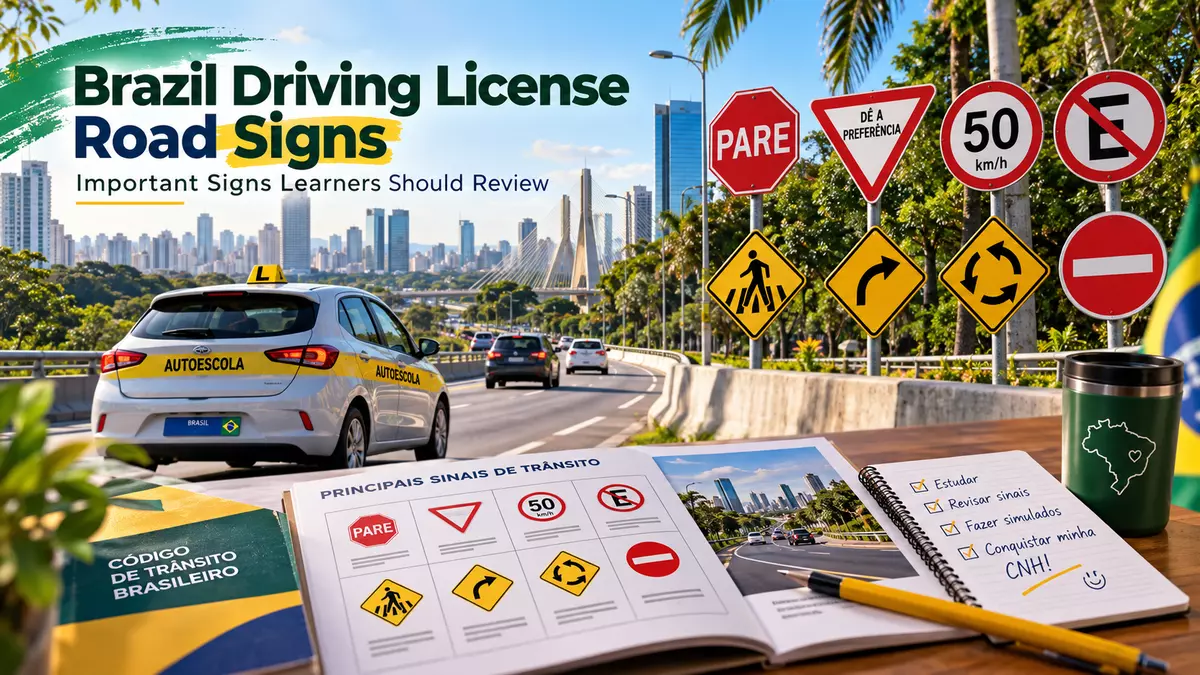
Road signs are one of the first things new drivers in Brazil need to understand properly. They appear throughout the theory stage, in driving-school lessons, and later during real road use, so learning them is not just about passing a test. It is about knowing how to react quickly and safely when the road situation changes.
If you are preparing for a Brazil driving license, it helps to study signs by purpose instead of trying to memorise dozens of symbols at once. Brazil follows a structured traffic-sign system with regulatory, warning, and indication signs, and each group gives the driver a different kind of instruction.
Regulatory signs tell drivers what they must do, what they must not do, or which restrictions apply on a road.
These are some of the most important signs to recognise before taking the theory test.
Common examples include:
Stop
Give Way
No Entry
Speed limits
No Parking
No Stopping
No U-turn
Mandatory direction signs
For someone applying for a Brazil driver license, it is useful to go beyond the visual symbol. Ask what the sign changes about your driving.
A speed-limit sign, for example, is not just a number inside a red circle. It sets the maximum permitted speed for that stretch of road, but traffic, rain, pedestrians, or poor visibility may still require you to drive more slowly.
The same applies to No Parking and No Stopping signs. They look similar to beginners, but they do not mean exactly the same thing. Understanding the difference can help with both theory questions and everyday driving.
Warning signs alert drivers to hazards or changes in road conditions ahead.
You may see signs for:
Sharp curves
Intersections
Roundabouts
Pedestrian crossings
School areas
Roadworks
Slippery roads
Narrow bridges
Steep slopes
Animals crossing
Traffic lights ahead
These signs do not always tell you to stop. Instead, they tell you to prepare.
That may mean reducing speed, increasing following distance, checking mirrors, or watching more carefully for pedestrians and other vehicles.
When studying for a Brazilian driving license, this is one of the best habits to develop: whenever you see a warning sign, ask yourself what risk it is pointing to and how your driving should change.
The Stop sign is one of the most recognisable signs in Brazil, but theory questions may test more than simple recognition.
A driver must make a complete stop and check whether it is safe to proceed. Rolling slowly through the junction is not the same as stopping.
Give Way is different. It requires the driver to yield priority when necessary, but it does not always require a full stop if the way is clear and the road rules allow you to proceed safely.
This difference is important for learners preparing for a Brazil driving license theory test because questions often focus on the correct action, not just the name of the sign.
Speed questions are common because they combine legal limits with driver judgement.
A posted limit tells you the maximum speed permitted on that road section. But good driving means adjusting your speed when conditions are not ideal.
You may need to slow down because of:
Rain
Fog
Heavy traffic
Roadworks
Poor road surface
Pedestrians
School zones
Sharp bends
For learners working toward a Brazil driver license, this is a useful reminder that safe driving is not always about driving at the maximum allowed speed.
Pedestrian safety is another important part of road-sign preparation.
Signs near crossings, schools, and busy urban areas are there to warn drivers that people may enter the road unexpectedly.
When you see a pedestrian crossing sign, do not just think of the sign itself. Think about the complete situation.
Is someone waiting near the crossing? Is visibility limited? Are children nearby? Is traffic slowing?
These details matter both in test questions and in real driving.
Not every sign tells you to stop, slow down, or avoid something.
Information and direction signs help drivers understand where they are going and what services or destinations are ahead.
These may include signs for:
City directions
Highways
Hospitals
Fuel stations
Parking
Tourist locations
Route numbers
Services
These signs are usually easier to understand, but learners should still recognise their shapes and colours because they can appear in theory materials.
For someone studying for a Brazilian driving license, they are also useful because they help build confidence when navigating unfamiliar roads.
Many learners focus on upright traffic signs and forget about markings painted on the road.
That can be a mistake.
You should understand:
Solid and broken centre lines
Lane dividers
Direction arrows
Stop lines
Pedestrian crossings
Bus-lane markings
Parking markings
Restricted areas
A road sign may tell you the rule, while the marking shows exactly where it applies.
For example, a Stop sign and a stop line work together. The sign gives the instruction, while the road marking helps indicate where the driver should stop.
Memorising the image of a sign can help at first, but it is not enough.
A better approach is to connect each sign with a driving situation.
When you see a warning sign for a curve, imagine how you would reduce speed and position the vehicle.
When you see a No Entry sign, think about why entering from that direction would create risk.
When you see a pedestrian crossing sign, think about observation, braking distance, and who has priority.
This kind of preparation is much more useful for a Brazil driving license test because it helps when questions are worded differently from the examples you practised.
Try studying signs in small groups rather than reviewing everything at once.
One day, focus only on regulatory signs.
The next day, study warning signs.
Then move to direction signs and road markings.
After that, take mixed practice questions and write down the signs you still confuse.
This approach makes revision easier and helps you see where your weak areas are.
Road signs are not something you stop using after you pass the theory test.
They are part of every drive.
Whether you are preparing for a Brazil driving license, reviewing rules for a Brazil driver license test, or learning more about the Brazilian driving license process, sign knowledge should become practical knowledge.
The best preparation is to understand what each sign means, what action it expects from you, and how it connects with road markings, priority rules, speed control, and other road users.
For more information about Brazil’s licence process, road rules, traffic signs, state-based preparation, and theory topics, visit the Brazil Driving Licence Guide and continue reviewing the areas you find most difficult.




Comment