


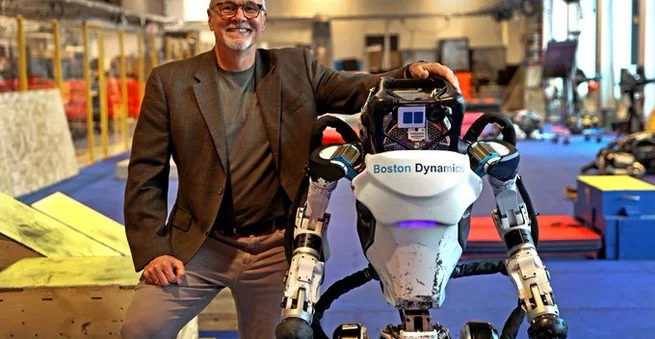
Boston Dynamics CEO Steps Down After Six Years
Boston Dynamics CEO Robert Playter is stepping down after six years at the helm, with CFO Amanda McMaster appointed as interim CEO. The leadership change takes effect immediately, and Playter will officially leave the company on February 27. The board has begun searching for a permanent replacement. The move comes during a pivotal moment for Boston Dynamics, as it expands commercial deployments of its humanoid and enterprise robots.
The sudden transition has sparked questions about what this means for the robotics pioneer’s future, especially as competition in AI-powered robotics intensifies.
Robert Playter’s Six-Year Tenure at Boston Dynamics
Robert Playter took over as CEO during a transformative chapter for Boston Dynamics. Under his leadership, the company navigated a major ownership shift, transitioning from SoftBank to Hyundai in 2021. That acquisition marked a turning point, giving Boston Dynamics deeper industrial backing and a stronger pathway to commercial scaling.
During Playter’s tenure, Boston Dynamics pushed beyond viral robot demos and focused on real-world deployment. The company accelerated commercialization of Spot, its quadruped robot used in industrial inspections and hazardous environments. It also advanced Stretch, designed to automate warehouse logistics.
Perhaps most notably, Boston Dynamics unveiled a fully electric version of its humanoid Atlas robot in 2024. The redesigned Atlas signaled a strategic shift toward practical, enterprise-ready humanoids rather than purely research-focused prototypes.
Atlas Robot Evolution Signals Commercial Ambitions
The all-electric Atlas marked one of the most significant milestones under Playter’s leadership. Earlier versions of Atlas relied on hydraulic systems, limiting their flexibility and commercial viability. The electric redesign improved agility, simplified maintenance, and positioned the robot for broader real-world applications.
Recent demonstration videos have showcased Atlas performing tumbling passes, outdoor runs, and dynamic maneuvers. While visually impressive, these demonstrations also serve a deeper purpose: proving reliability, balance, and adaptability for industrial settings.
As enterprise-ready editions begin rolling out, Boston Dynamics appears to be transitioning from experimental robotics to scalable automation solutions. That shift makes leadership continuity especially critical.
Amanda McMaster Named Interim CEO
Following Robert Playter’s departure announcement, CFO Amanda McMaster has stepped in as interim CEO. McMaster brings financial and operational expertise at a time when Boston Dynamics is balancing innovation with revenue growth.
Her appointment suggests the board is prioritizing stability during the transition. As CFO, McMaster has been closely involved in strategic planning, investment allocation, and commercial expansion efforts. That experience may help maintain momentum while the search for a permanent CEO unfolds.
The board has not indicated a timeline for selecting a successor, but the robotics industry will be watching closely. Leadership decisions at this stage could influence product direction, partnerships, and long-term commercialization strategy.
Why This Leadership Change Matters for Robotics
The robotics sector in 2026 is far more competitive than it was six years ago. Advances in artificial intelligence, battery technology, and edge computing have accelerated humanoid and warehouse automation development across the industry.
Boston Dynamics has long been known for its technical excellence and viral robot demonstrations. However, the next phase of growth depends less on spectacle and more on scalable, revenue-generating deployments.
A CEO transition during this shift raises key questions:
-
Will the company double down on humanoid robots?
-
Will enterprise logistics remain the primary focus?
-
How aggressively will Boston Dynamics pursue global expansion?
The answers may define its role in the broader automation economy.
Hyundai’s Role in Boston Dynamics’ Future
Since the 2021 acquisition, Hyundai has played a central role in shaping Boston Dynamics’ commercialization strategy. The automotive giant has provided manufacturing expertise, global distribution networks, and industrial integration opportunities.
Leadership changes often reflect evolving priorities between parent companies and subsidiaries. While there is no indication of strategic conflict, the transition could align Boston Dynamics more closely with Hyundai’s long-term automation vision.
Industrial robotics, smart factories, and mobility platforms represent high-growth sectors. A new CEO may emphasize tighter integration with automotive manufacturing and logistics ecosystems.
What’s Next for Boston Dynamics?
Despite the leadership shift, Boston Dynamics continues to demonstrate rapid technical progress. Enterprise customers are increasingly testing humanoid robots for repetitive and physically demanding tasks. Meanwhile, Spot and Stretch remain core commercial products in inspection and warehouse automation.
Short-term priorities will likely include:
-
Scaling production capacity
-
Expanding enterprise partnerships
-
Improving cost efficiency of humanoid systems
-
Strengthening AI-driven autonomy
The company’s ability to balance innovation with profitability will determine its trajectory over the next decade.
A Pivotal Moment for a Robotics Pioneer
Robert Playter’s departure closes a defining chapter for Boston Dynamics. His tenure bridged the gap between research-focused robotics and enterprise-ready solutions. The launch of the electric Atlas and expansion of commercial platforms marked meaningful progress toward sustainable growth.
Amanda McMaster now faces the challenge of maintaining stability while the board searches for long-term leadership. For investors, engineers, and enterprise customers alike, this moment signals both uncertainty and opportunity.
Boston Dynamics has always thrived on pushing technical boundaries. The question now is whether its next leader can translate that innovation into lasting commercial dominance.


Array