Alerts

-
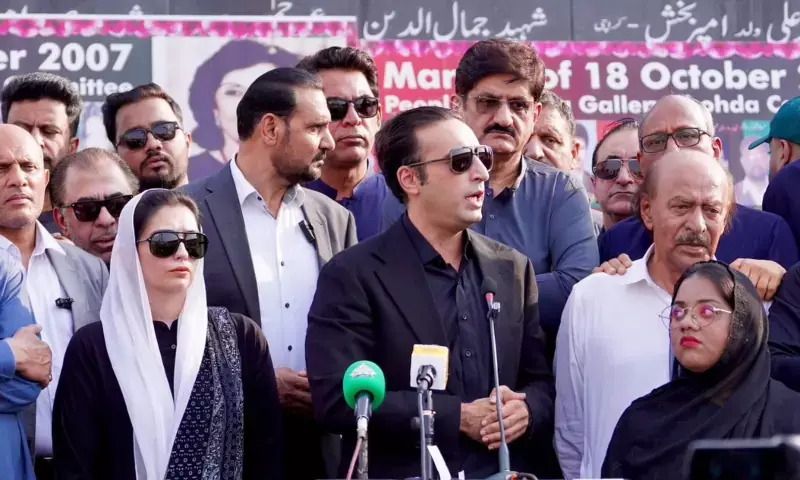
PPP Chairperson Bilawal Bhutto-Zardari said on Sunday that if the opposition was willing to fight against terrorism and engage with the Centre on a plan, governor’s rule and emergency imposed in Khyber Pakhtunkhwa could end. He made these remarks while speaking to the media in Karachi, where he was visiting the Karsaz Monument on the 19th anniversary of the Karsaz bombing. His statement comes a week after the Centre imposed governor’s rule and emergency in KP, citing the provincial government’s “deliberate disengagement” from the fight against terrorism. The move also followed a mobilisation drive and protest march by the PTI, which was in power in KP and in opposition in the Centre, to demand the release of its jailed founder, Imran Khan. “If they really want to fight terrorists, and if they want that emergency and governor’s rule in KP to end, they should engage with the federal government and politicians and discuss a united policy regarding the fight against terrorism,” Bilawal said on Sunday, referring to the PTI-led opposition. He added that if the opposition was ready to fight terrorism and “we agree on a plan” to do so, the emergency and governor’s rule in KP could end. “If the Khyber Pakhtunkhwa chief minister (Sohail Afridi) is a coward, if he is not ready to defend his homeland, if he is not ready to fight those terrorists, then the PPP is ready to fight them,” Bilawal said. “That is why we supported the government’s decision to impose governor’s rule in KP.” He stressed that the party would “join forces with everyone to fight these terrorists”. In his media talk, the Bhutto scion said the country had reached a point where “terrorist attacks are taking place from Khyber to Khuzdar”. He regretted that when the Taliban came to power in Kabul in 2021, the Pakistani government at that time “also decided to invite the terrorists who were in Afghanistan to come back and live in our Swat, our Malakand, our former tribal areas”. He was seemingly referring to then-prime minister Imran’s plans to resettle members of the Tehreek-i-Taliban Pakistan in the country. Bilawal went on to say that terrorists who were in jail in Pakistan were also freed. “Today, Pakistan is suffering the losses from these wrong decisions,” he lamented. He added that the country had now once again reached the point where “some forces want to take down Pakistan’s flag in Swat” and there was a fight against terrorism ongoing across the entire country, while security forces, law enforcers and the public were being targeted. However, he claimed, in the province where the highest number of terrorist incidents were taking place — KP — its chief minister had pledged that he would not face the terrorists. In response to a question about the Karsaz bombing, the PPP chairman remarked that the greatest loss was caused when terrorist incidents were not taken seriously. He said that the PPP had “prepared entire society” to fight terrorism by creating an environment for counterterrorism operations in 2008, when the party was in power. After that, he said, when the National Action Plan was introduced, the PPP adopted a holistic approach towards bringing changes in institutions to assist with combatting terrorism. He emphasised that success was achieved when “every citizen” of Pakistan joined the fight against terrorism, saying, “Today as well, we will make efforts to create an environment where we are all united, and will fight the terrorists together.” Answering further questions, he said Pakistan was facing a “historic economic crisis”. “It appears that the situation will worsen. Our priority is to address this economic crisis, and to do that, we will have to fight terrorism as well,” he added. He said efforts should also be made to improve the democratic and electoral system in Pakistan. For this reason, he said, the PPP had highlighted the need for a new NAP and consensus on the fight against terrorism, while also extending an invitation to the opposition to play a part in this. He said the PPP also made an effort to improve the democratic system by pushing for electoral reforms. To this end, the federal government had decided to establish an electoral reforms committee in the National Assembly, adding that he had invited the opposition to play their part in that committee as well. “If they say that democracy is weak in this country, they should help us to strengthen it,” the PPP chairman said. He added, “If we can create such an environment, we will be in a better position to fight terrorists.” Bilawal also said KP Governor Faisal Karim Kundi had been nominated by the PPP for the office of governor, but “constitutionally, he is now a representative of the federal government”. He said Kundi reported to the federal government, but “I will keep talking to him and keep advising him; in principle, though, he is now working together with the federal government”. Responding to a question regarding a potential “compromise” with the opposition, Bilawal said, “You say ‘compromise’ like it’s a bad word […] Compromise and politics go hand in hand.” He stressed that ex-PM Benazir had always strived for compromises during her political career, adding that she knew that one could reach “extremes” if they remained a revolutionary or an activist who only protested rather than working for their cause. “We had to solve our issues and lift the public and our workers out of difficulty,” Bilawal said about the PPP’s past tenures in government. He asserted that it was the result of the PPP’s “compromises” that led to the end of Gen Pervez Musharraf’s dictatorship, as well as the passage of the 1973 Constitution and the 18th Amendment. “We (the PPP) are not in the federal government. Nor do we have a majority in Parliament,” he said. “But [we have to see] how we can conduct politics in the space we have.” New provinces Answering a question regarding the creation of new provinces, Bilawal stated that Interior Minister Mohsin Naqvi knew “clearly” what the PPP and President Asif Ali Zardari’s policy was regarding new provinces or administrative units, and that this was “not possible without the president’s signature”. Naqvi’s July remarks calling for new provinces and reforms in the current governance system had ignited an animated debate across the country. The PPP, which rules Sindh, has strongly opposed any possible division of the province. Bilawal stressed that the PPP’s position was clear: that they could be created in accordance with the Constitution and law if the provincial assembly agreed. The Sindh Assembly, amid a boycott by the opposition, adopted a resolution last month rejecting all attempts to divide the province or create new administrative units. “Where there is consensus and it is not a political stunt, if there is no other purpose behind it … why aren’t provinces being made there?” the PPP chairman said, giving the example of Gilgit-Baltistan. “If we really want this to be implemented, it must only be implemented where the provinces want this,” he stressed, noting that the entire GB Legislative Assembly had passed a resolution with consensus for the region’s constitutional rights. Bilawal requested politicians, whether on the treasury or opposition benches, not to politicise the issue of terrorism or create controversy out of steps taken to combat it, but rather to play their role in fighting it. Bilawal also spoke about Jamiat Ulema-i-Islam (JUI-F) chief Maulana Fazlur Rehman, saying he had the right to criticise the government’s policies, and that there should certainly be room for difference of opinion in the country. He said the PPP had always imposed emergency through constitutional and legal means. “In fact, during the 2008–2013 government, when emergency rule was imposed in Balochistan, it was also because of the terrorism situation, and governor’s rule was imposed there against the PPP’s own government. “If the PPP thought only of itself, how would it have removed its own government?“ He said Fazl’s party has also been affected by terrorist attacks, so he hoped the JUI-F chief would criticise the PPP politically as much as he wished, but also condemn the terrorists. Bilawal added that if Fazl made an effort, harmony between the government and the opposition could be achieved.





Comment