
Trending
Trending Hashtags
Alerts
-
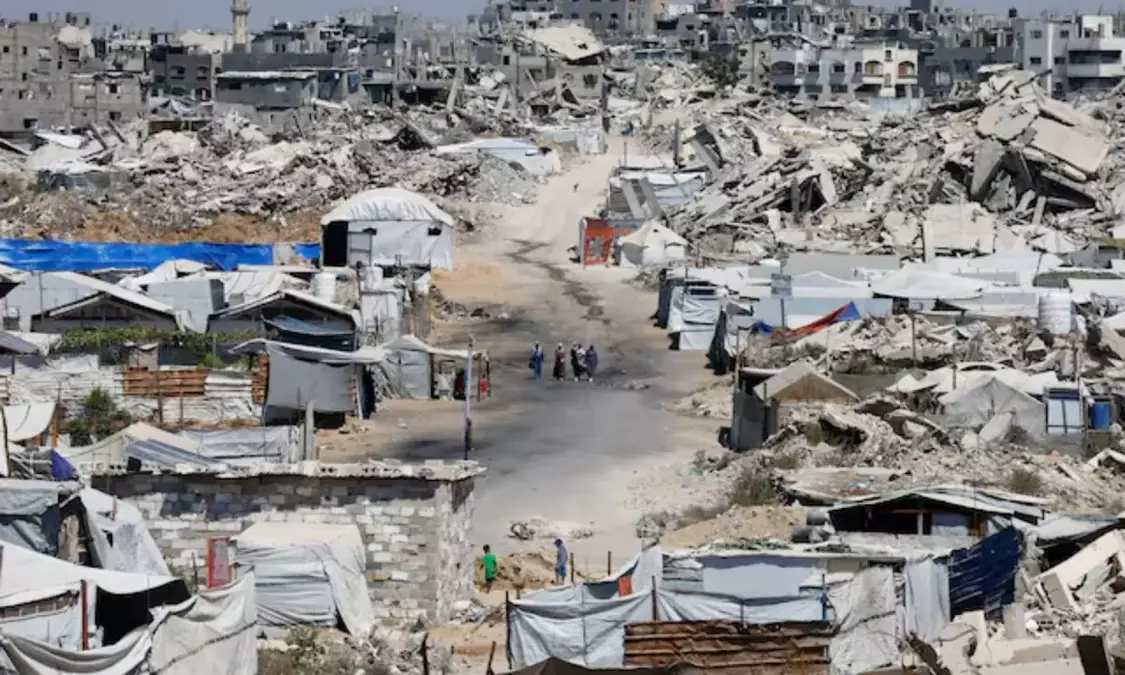
On February 29, 2024, Israeli forces fired at civilians as they gathered around an aid convoy. At least 115 people were killed in what has since become known as the ‘Flour Massacre’. Survivors recalled the involvement of armed tanks and quadcopters. “When the aid entered, the tank and quadcopter started firing at the people gathered, the people who went to get food for themselves and their children. They started shooting at them,” Mahmoud Ahmad, a Gaza resident, told Reuters shortly after the incident. Screenshot from video released by Israeli forces/Anadolu Agency Powered by artificial intelligence (AI), Israel’s strategy of keeping soldiers “out of harm’s way” while they kill Palestinians relies on quadcopter drones and various AI systems to identify and target people. Three years of remote-controlled targeting of civilians has fuelled the apartheid state’s seemingly unquenchable thirst for blood. Quadcopters such as the ‘Bird of Prey’ — designed by Elbit Systems, the apartheid state’s largest arms manufacturer — have contributed to the deaths of Palestinians in Gaza, where more than 70,000 people have reportedly been killed since the beginning of the genocide. According to the manufacturer, the ‘Bird of Prey’ quadcopter drone is designed to enable “fast and accurate” targeting and is light enough to fit into a soldier’s backpack. The drone can transmit high-quality footage in real time, facilitating precision targeting. According to the Euro-Med Human Rights Monitor, at least 60 civilians have been killed by fire or munitions dropped from these drones since the October 2025 ceasefire till early September 2026. As Israeli weapons manufacturers boast about the accuracy of the targeting capabilities their drones are fitted with, it is easy to surmise that Israeli forces are deliberately targeting unarmed civilians. In April 2024, reports surfaced online of drones playing sounds of crying babies and screaming women and children to lure residents and kill them. Palestinians inspect the site of a house targeted by Israeli airstrikes after the Israeli military warned residents to evacuate late on Saturday, in Al-Zawayda, central Gaza Strip on October 11, 2026. —Reuters Lavender According to Palestinian-Israeli news outlet +972 Magazine, the Lavender system was designed to identify suspected members of the military wings of Hamas and Palestinian Islamic Jihad (PIJ) as potential targets for air strikes. The publication reported that human oversight of the system was minimal, with one intelligence officer describing his role as little more than a “stamp of approval” for attacks. According to the report, Lavender’s accuracy was estimated at 90 per cent, meaning that around 10 per cent of those it identified as targets were incorrectly classified. The report also said that, during the early weeks of the war, Israeli military officials permitted strikes against suspected junior-level fighters even when they risked killing up to 15 to 20 civilians. The report alleged that these policies facilitated attacks that caused extensive civilian casualties in Gaza. “They could target someone who is a photography personnel or a truck driver and take another 15 people down with him,” a testimonial on Breaking the Silence — a digital archive of Israeli atrocities against Palestinians — revealed. Twenty seconds. That’s the time given to consider whether a target should be bombed and if that target is male. The Israeli army’s use of AI systems such as Lavender further enabled blanket targeting of Palestinians. Another entry spoke of how a single target could result in hundreds of ‘casualties’. “That they knowingly authorised a strike. I don’t know what number they authorised exactly, but they knew it would be more than a hundred [civilian deaths].” The entries dated 2023 are an astonishing admission of targeted strikes on civilians. Where’s Daddy? ‘Where’s Daddy?’ is an automated system used to track people and identify them for targeting when they enter their homes. According to reports, the system was designed to target individuals at their residences. It has been linked to the deaths of thousands of civilians, including women and children. “It’s much easier to bomb a family’s home,” an Israeli officer told +972 Magazine. Habsora A third system, Habsora, also known as ‘The Gospel’, was designed to identify buildings and infrastructure allegedly linked to Hamas for targeting. Israel has accused the Palestinian group of using essential infrastructure, including hospitals, schools, UNRWA buildings and mosques, for military purposes. These allegations have been disputed, and the resulting attacks have caused extensive destruction across the besieged enclave, where approximately 82 per cent of buildings have reportedly been damaged or destroyed. Who is responsible for these AI controlled attacks? The Israeli military’s main intelligence unit, Unit 8200, has been at the centre of cyberwarfare. The unit was established in 1948, the same year the state of Israel was founded. From its inception, Israel has developed mechanisms of surveillance and control. Other systems include facial recognition systems such as Red Wolf and Blue Wolf. A 2020 testimony published by Breaking the Silence describes Israeli soldiers photographing Palestinians’ identity cards and compiling a database for the Blue Wolf system. Blue Wolf then displays different colours depending on whether it recognises an individual. A yellow light gives Israeli forces the option to detain that person, while a red light signals that they should be arrested. In its 2023 report, Israel and Occupied Palestinian Territories: Automated Apartheid: How Facial Recognition Fragments, Segregates and Controls Palestinians in the OPT, Amnesty International found that Israeli soldiers used a gamified system to map Palestinian identities. Soldiers were reportedly rewarded for photographing Palestinians without their consent. In 2024, Muhammad Ahmad Odeh recounted to Euro-Med Human Rights Monitor how a quadcopter killed his sister in Gaza and described what happened afterwards. “After just two or three hours, a small aircraft flew in and took pictures of us inside the house. The army forces then moved in and started shooting at us. They fired sound shots, causing a state of panic among the women and children.” Terror Beyond Palestine Ambulances arrive at American University of Beirut Medical Center (AUBMC) as more than 1,000 people, including Hezbollah fighters and medics, were wounded when the pagers they use to communicate exploded across Lebanon, according to a security source, in Beirut, Lebanon on September 17, 2024. —Reuters/File Israel’s AI warfare systems have been used beyond Gaza and the occupied West Bank. In September 2024, thousands of pagers and other communication devices exploded across Lebanon in an operation attributed to Israel. The attack, which some Western media outlets compared to a ‘James Bond’-style operation, killed at least 12 people, including children. US Central Command chief Admiral Brad Cooper confirmed that the US military was using advanced AI tools in the war against Iran. “Humans will always make final decisions on what to shoot and what not to shoot, and when to shoot,” Cooper said in a video message in March 2026. The US-Israel war on Iran has targeted civilian infrastructure, including a girls’ school in Minab, where 170 schoolgirls were killed. The US dismissed the strike as a mistake, but Israel’s impunity in Gaza has done little to protect civilians. The evidence cited above suggests a pattern of deliberate targeting of civilians. The rabbit hole of Israeli cyberwarfare runs much deeper, with new branches dedicated to AI weaponry being established. According to Israeli military Chief of Staff Lt Gen Eyal Zamir, the Unmanned Systems and Artificial Intelligence Branch is scheduled to become operational in December 2026. The new branch will be responsible for further developing and deploying the Israeli state’s various AI-powered and unmanned systems. Image header: People walk at a site destroyed during the Israeli offensive, in Beit Lahiya, in the northern Gaza Strip on August 18, 2026. —Reuters/File









Comment