
-
7 minutes, 36 seconds
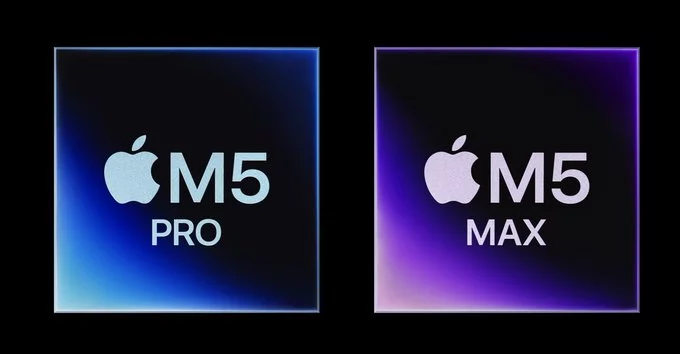
Apple M5 Pro and M5 Max are officially here, and they power the latest MacBook Pro models with significant CPU, GPU, and AI upgrades. The new chips introduce a “Fusion Architecture” that combines two 3nm dies into a single system-on-a-chip, delivering stronger multithreaded performance and improved efficiency. Both processors feature an 18-core CPU setup and upgraded GPU capabilities, including enhanced ray tracing and a more powerful neural accelerator.
Apple says these new chips are optimized for professionals who need high performance without sacrificing battery life — a key concern for creators, developers, and AI-focused workflows.
At the heart of the M5 Pro and M5 Max is Apple’s new Fusion Architecture. This design integrates two 3-nanometer dies into one unified chip, effectively increasing processing power while maintaining energy efficiency.
By combining dies at the silicon level, Apple reduces latency between components and improves data transfer speeds inside the chip. That means faster rendering, smoother multitasking, and better responsiveness in demanding applications.
This architectural shift also positions Apple to scale performance further in future generations. Fusion Architecture is not just a spec upgrade — it represents a strategic move toward more modular, high-density chip designs.
Both M5 Pro and M5 Max come equipped with an 18-core CPU configuration. The setup includes six “super” cores and 12 all-new performance cores.
Previously known simply as performance cores, Apple now refers to its most powerful cores as “super cores,” signaling a meaningful performance boost. These cores are engineered to handle intense workloads such as 4K video editing, 3D rendering, and complex code compilation.
The 12 additional performance cores are designed for optimized multithreaded tasks. According to Apple, the new architecture delivers up to 2.5 times faster multithreaded performance compared to the M1 Pro and M1 Max generation. For users upgrading from older Macs, that jump could translate to noticeably shorter export times and smoother creative workflows.
Artificial intelligence is now central to modern computing, and Apple is clearly leaning into that trend with the M5 series. Each GPU core includes a neural accelerator, boosting AI-driven tasks significantly.
Apple claims the M5 Pro and M5 Max deliver more than four times the peak AI compute compared to the previous generation. That means faster on-device AI processing for features like image enhancement, machine learning model training, and real-time background effects.
As AI-powered tools become standard in creative and productivity software, this hardware-level acceleration ensures that MacBook Pro users stay ahead of performance demands. It also reduces reliance on cloud-based AI processing, improving privacy and lowering latency.
Graphics performance also sees a major upgrade in the M5 Pro and M5 Max. The chips introduce enhanced ray-tracing capabilities, allowing for more realistic lighting, reflections, and shadows in supported applications.
For developers and designers working in 3D environments, this means more accurate visual previews and faster rendering times. Gamers on macOS may also benefit, as ray tracing continues to gain traction across platforms.
By embedding a neural accelerator into every GPU core, Apple ensures that graphics performance and AI acceleration work hand in hand. The result is a more balanced system that can handle both visual and computational workloads efficiently.
High performance often comes at the cost of battery life, but Apple continues to emphasize efficiency. The 3nm manufacturing process plays a key role here, allowing more transistors to fit into a smaller space while consuming less power.
Apple describes the new cores as optimized for “greater power-efficient, multithreaded performance.” In practical terms, that means sustained heavy workloads without rapid battery drain or excessive thermal throttling.
For professionals who rely on MacBook Pro devices for on-the-go editing, coding, or design, this balance between power and efficiency remains one of Apple’s strongest advantages.
Compared to the M1 Pro and M1 Max, the improvements are significant. Multithreaded performance is up to 2.5 times faster, AI compute is more than four times stronger, and GPU capabilities are noticeably enhanced with advanced ray tracing.
For users already running M3 or M4 series chips, the jump may feel more incremental. However, those using older Intel-based Macs or early Apple silicon models will likely experience a transformative upgrade.
Apple appears to be targeting creative professionals, AI developers, and high-end users who demand consistent, sustained performance across multiple intensive tasks.
Computing needs are evolving quickly. AI workloads, real-time rendering, and hybrid cloud-local workflows are becoming mainstream. The M5 Pro and M5 Max are clearly designed with that future in mind.
By combining Fusion Architecture, expanded core counts, improved GPU ray tracing, and a dramatically stronger neural accelerator, Apple is positioning the MacBook Pro as a powerhouse for the AI era.
The M5 Pro and M5 Max aren’t just faster chips — they signal Apple’s continued push toward tightly integrated, high-performance silicon built for the next wave of professional computing.
As the demand for AI acceleration and high-efficiency performance grows, Apple’s latest chips show that the company is betting big on in-house silicon innovation. For power users and creative professionals, that bet could pay off in faster workflows, better visuals, and smarter computing experiences.

2.6K articles

1.4K articles

34 articles

28 articles














Comment