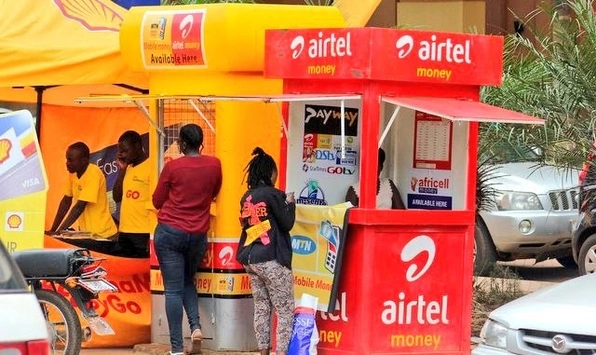
Airtel Uganda dividend rise has captured investor attention after the telecom giant lifted its total payout to Sh0.41 per share, up 41.5% from Sh0.28 a year earlier. For the year ended December 2025, shareholders will receive USh11.15 per share. Net profit surged 41% to Sh16 billion (USh466.86 billion), while revenue increased 13.3% to Sh80.75 billion (USh2.25 trillion).
Those figures answer the question many investors have been asking: Is the dividend growth backed by real earnings? The numbers suggest yes. Profit growth closely mirrors the dividend increase, reinforcing management’s commitment to its long-standing payout strategy.
Board directors recommended a final dividend of USh142 billion (Sh5.09 billion), bringing the total annual distribution to USh446 billion (Sh16 billion). That consistency signals financial discipline rather than a one-off windfall.
Beyond the headline payout, a deeper structural shift is underway. Data revenue has finally overtaken traditional voice services, marking a turning point for the company’s revenue mix.
For years, voice calls formed the backbone of telecom earnings across East Africa. Now, smartphone penetration, affordable data bundles, and digital services are reshaping consumer behavior. Streaming, social media, fintech apps, and remote work tools are driving sustained data consumption growth.
This transition matters. Data services typically offer stronger long-term scalability, especially as networks expand 4G coverage and prepare for future upgrades. While voice revenue remains important, its growth trajectory is flattening. Data is becoming the engine that powers both revenue expansion and investor confidence.
The company continues to distribute a minimum of 95% of net profit, paid quarterly. On paper, that policy is attractive. Yield-focused investors benefit from predictable, generous returns. In volatile frontier markets, steady dividends often act as a stabilizer against currency swings and political uncertainty.
However, telecom remains a capital-intensive business. Spectrum licensing, tower expansion, fibre backhaul, rural connectivity projects, and energy costs for off-grid infrastructure demand constant funding. Retaining only 5% of net earnings leaves limited room for aggressive capital expenditure unless operating cash flow remains robust.
This is not necessarily a weakness. It reflects a deliberate growth model: disciplined, yield-driven, and efficiency-focused rather than expansion-at-all-costs. Investors appear comfortable with that trade-off—for now.
Infrastructure bills continue to grow as data usage increases. Each new subscriber streaming video or using cloud-based applications adds pressure to network capacity. To maintain service quality, ongoing investment is unavoidable.
Energy costs are another factor. Many rural base stations operate on hybrid power systems, where fuel price volatility can affect margins. Meanwhile, fiber network expansion remains essential to support higher data speeds and enterprise clients.
Balancing high dividend payouts with expanding infrastructure needs requires careful financial management. Strong operating cash flows have so far supported both objectives. The real test will come if capital expenditure requirements accelerate faster than revenue growth.
Dividend growth does not exist in a vacuum. Regulators in Uganda have consistently emphasized local participation in telecom ownership structures. A generous payout policy strengthens domestic investor confidence and supports broader capital market development.
Higher dividends also send a signal of financial health and governance stability. For institutional investors, particularly pension funds, consistent returns enhance portfolio reliability.
At the same time, regulators often expect telecom operators to continue expanding coverage, especially in underserved areas. Meeting those obligations while maintaining a 95% payout will require operational efficiency and disciplined cost management.
The arithmetic is straightforward. Profit up roughly 41%. Dividend up roughly 41%. Revenue growing at a steady double-digit pace. That alignment strengthens management credibility.
For investors, the appeal lies in the combination of income and moderate growth. The telecom sector may no longer deliver explosive expansion, but it offers resilience. Data demand shows little sign of slowing, and digital transformation across East Africa remains in early stages.
Market watchers note that high payout ratios can amplify stock attractiveness in low-interest environments. When fixed-income yields fluctuate, dividend-paying equities often become alternative income vehicles.
Looking ahead, sustainability hinges on three key variables: data growth momentum, cost discipline, and capital expenditure efficiency.
If data consumption continues rising at current rates, revenue expansion could comfortably support both dividends and moderate infrastructure investment. However, unexpected regulatory costs, spectrum fees, or currency depreciation could pressure margins.
Management’s challenge will be preserving flexibility without diluting shareholder returns. A 95% payout signals confidence. It also leaves limited margin for error.
Airtel Uganda dividend rise is more than a payout story. It represents a structural shift in revenue composition, a reinforcement of investor trust, and a statement of financial discipline.
Data has officially overtaken voice. Profitability is climbing. Shareholders are being rewarded generously. Yet beneath the surface, infrastructure costs and digital demand continue to expand.
Investors see rising payouts. Regulators see local capital participation. Customers see faster data speeds. Somewhere in between, the infrastructure bill keeps growing.
For now, the balance holds—and that equilibrium may define the next chapter of Uganda’s telecom evolution.
Airtel Uganda Dividend Rise Signals Data Era ... 0 0 0 0 2
2 photos





Array