AI Video Game Worlds Are Still Missing the Magic
Searches around AI video game worlds often ask one question: can generative AI build immersive games yet? Early experiments suggest the answer is still no. Despite massive hype around AI creativity, recent demos like Project Genie show that AI-generated environments feel shallow, repetitive, and unfinished. While tech giants promise a revolution, players and developers are questioning whether machines can truly match the depth of human-designed worlds.
Generative AI has transformed text, art, and even coding. Naturally, gaming became the next frontier. Yet unlike images or chatbots, video game worlds demand something more complex: systems that feel alive, layered, and emotionally engaging. That’s where current AI tools are struggling most.
Procedural Worlds Already Existed Before AI
Long before generative AI became a buzzword, games were already creating dynamic worlds. Classic titles like Minecraft and early roguelikes such as Rogue built entire experiences through procedural generation. These games relied on rules designed by human developers, not machine learning models.
The difference matters. Procedural systems are handcrafted frameworks where developers carefully tune randomness. Designers decide how biomes connect, how resources appear, and how gameplay unfolds. That human intention gives procedural games longevity, allowing them to feel fresh even after years of play.
Generative AI, by contrast, attempts to learn patterns from data and generate content automatically. It promises scale, but often sacrifices intentional design. That trade-off is becoming increasingly obvious as experiments emerge.
Project Genie Shows the Limits of AI Creativity
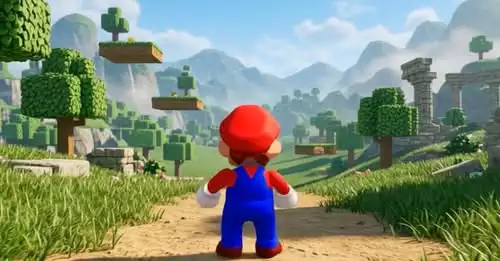
Project Genie recently generated buzz as an example of AI-driven game creation. The demo produced playable environments entirely through generative AI. On paper, it sounded like a glimpse into the future of instant game worlds.
Reality felt more underwhelming. The generated environments lacked cohesion and meaningful interaction. Worlds appeared visually interesting at first glance but quickly revealed their emptiness. There were few surprises, limited mechanics, and little sense of narrative purpose.
This highlights a core limitation of current generative models. AI can remix patterns, but designing fun gameplay requires understanding motivation, pacing, and emotional payoff. Those are qualities machines still struggle to replicate convincingly.
Gamers and Developers Are Pushing Back
Generative AI has become one of the most divisive topics in gaming. Many players worry about “AI slop” — low-effort content flooding stores and live-service games. Developers are also split, with surveys showing nearly half skeptical about AI’s long-term impact on creativity.
Unlike productivity tools, games are deeply personal experiences. Players notice when something feels soulless. That sensitivity is fueling resistance against AI-generated assets and worlds, especially when studios use them as shortcuts.
The backlash mirrors similar debates in art, music, and writing. However, gaming adds another layer: interactivity. If AI struggles to create compelling static art, building engaging interactive worlds becomes exponentially harder.
Big Studios Are Still Betting on AI
Despite skepticism, major studios are moving ahead. Companies like Krafton have openly embraced an “AI-first” vision for development. Meanwhile, partnerships between industry players and AI firms signal continued investment in the space.
For example, Electronic Arts has explored collaborations with Stability AI to build generative tools. Other publishers, including Ubisoft, are reorganizing teams to integrate AI deeper into production pipelines.
From a business perspective, the appeal is obvious. AI promises faster development cycles and reduced costs. Procedural generation took decades to mature; companies hope generative AI can accelerate that evolution dramatically.
But speed doesn’t guarantee quality. And in gaming, quality is everything.
Why AI Struggles With Game Worlds
Creating a compelling video game world involves far more than visuals. It requires systems that interact meaningfully over time. Storylines, environmental storytelling, physics, progression loops, and player agency must all align.
Generative AI currently excels at pattern recognition, not systemic design. It can generate textures, dialogue snippets, or terrain layouts. Yet it struggles with emergent gameplay — the unpredictable moments that define memorable gaming experiences.
Human developers rely on intuition built from years of play and iteration. They design worlds with emotional arcs in mind. AI lacks that lived context, making its creations feel technically impressive but emotionally hollow.
Could AI Ever Catch Up?
Some technologists believe today’s limitations are temporary. As models grow more sophisticated and integrate simulations, AI-generated worlds could evolve dramatically. Hybrid workflows — where humans guide AI tools — may become the norm.
Others are less optimistic. They argue that creativity rooted in human experience cannot be fully replicated through data training. Games are cultural artifacts, shaped by emotion, history, and lived perspective. Those ingredients are difficult to encode into algorithms.
The truth likely sits somewhere in the middle. AI may become a powerful assistant for worldbuilding rather than a replacement for designers. That shift would mirror how AI is already used in art and writing — augmenting creativity rather than replacing it.
The Future of AI Video Game Worlds
Short-term expectations should remain realistic. Generative AI will continue improving tools for prototyping environments, generating assets, and testing mechanics. Indie developers may benefit the most, using AI to accelerate early-stage development.
Fully AI-generated blockbuster worlds, however, still feel far away. Players expect depth, polish, and emotional resonance. Delivering those elements requires more than algorithms — it demands vision.
Project Genie and similar experiments are valuable not because they prove AI’s dominance, but because they reveal its limits. Each failed demo teaches the industry where human creativity still matters most.
AI video game worlds are advancing quickly, but they haven’t reached the level of handcrafted experiences. Early experiments show that while AI can generate environments, it struggles to create worlds that feel alive and meaningful. Developers and gamers alike are recognizing that immersive games depend on more than automation.
Generative AI will almost certainly reshape game development workflows. Yet if current trends hold, the best worlds will still be built with a human touch — guided by creativity, emotion, and intentional design that machines have yet to master.





Array