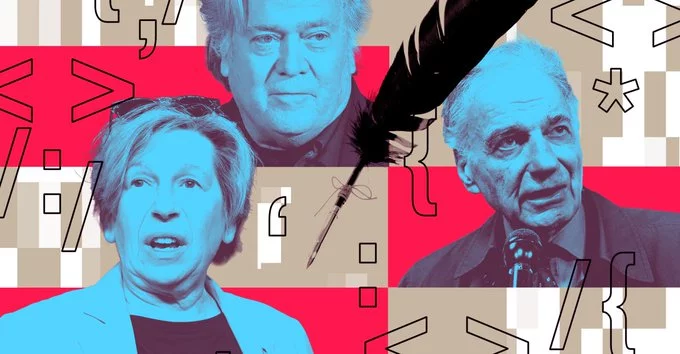
AI political resistance is no longer a fringe conversation. A secret January meeting brought together nearly 90 political, community, and thought leaders who are now shaping a growing national movement around artificial intelligence policy. The result? A bold “Pro-Human Declaration” signed by major organizations including the American Federation of Teachers, the Congress of Christian Leaders, the Progressive Democrats of America, and former White House strategist Steve Bannon.
What happened behind closed doors could signal a new era in the battle over AI regulation, democracy, and human autonomy.
At the heart of the AI political resistance movement is the Pro-Human Declaration — a document designed to frame artificial intelligence as not just a technological issue, but a moral and political one.
Supporters argue that AI systems are reshaping labor markets, influencing elections, and altering how information spreads — often without adequate public oversight. The declaration emphasizes protecting human jobs, defending democratic institutions, and ensuring AI tools remain accountable to citizens rather than corporations or governments.
Unlike typical tech policy debates focused on innovation and economic growth, this coalition’s language centers on dignity, human agency, and constitutional safeguards. The framing is deliberate: the movement wants AI governance to become a kitchen-table issue, not a niche policy concern.
Perhaps the most striking development is the coalition’s diversity. The American Federation of Teachers — one of the nation’s largest labor unions — joined forces with faith-based groups like the Congress of Christian Leaders. Meanwhile, progressive activists from the Progressive Democrats of America signed the same document as conservative strategist Steve Bannon.
This unusual alignment suggests AI regulation is emerging as a cross-ideological concern. For labor advocates, AI threatens job security and wage stability. For religious leaders, the anxiety centers on ethical boundaries and human identity. For political activists across the spectrum, the concern is concentrated power — whether in Silicon Valley or Washington.
Such coalitions are rare in modern politics. That alone makes the AI political resistance movement noteworthy.
Timing is everything. Artificial intelligence has moved from experimental labs into daily life at unprecedented speed. Generative AI tools are influencing education, political campaigns, journalism, and even military planning. Policymakers are racing to catch up.
Sources close to the gathering describe the January meeting as strategic rather than symbolic. Organizers reportedly discussed coordinated messaging, legislative outreach, and media strategy. The goal: shape public opinion before AI governance frameworks become entrenched.
In political terms, this is about narrative control. If AI policy is defined solely by tech executives and regulators, the coalition fears everyday citizens will be sidelined.
AI political resistance arrives at a moment of heightened polarization. Technology companies wield significant influence in lobbying and policymaking. Meanwhile, voters are increasingly skeptical of both Big Tech and Big Government.
The Pro-Human Declaration taps into that sentiment. It frames artificial intelligence not as inherently evil, but as powerful — and therefore requiring democratic guardrails. That positioning could resonate with voters who feel overwhelmed by rapid technological change.
Political analysts note that AI is likely to become a defining issue in upcoming campaigns. Debates over surveillance, automated decision-making, and digital propaganda are already shaping policy proposals.
For teachers’ unions like the American Federation of Teachers, AI raises immediate concerns about classroom integrity and student data privacy. Automated grading systems and generative tools are transforming education faster than many districts can regulate.
Faith leaders, represented by the Congress of Christian Leaders, emphasize moral responsibility. They argue that replacing human judgment with algorithms risks eroding accountability and spiritual values.
On the activist front, groups like the Progressive Democrats of America view AI consolidation as an economic justice issue. They warn that unchecked automation could deepen inequality and shift power further toward corporate elites.
Meanwhile, figures like Steve Bannon frame AI as a sovereignty issue — arguing that national control over technology development is critical to maintaining democratic independence.
Despite ideological differences, all factions converge on one central idea: humans must remain in control.
Insiders suggest the coalition is focused on three core strategies. First, broad public education about AI’s societal impact. Second, bipartisan legislative proposals that prioritize transparency and accountability. Third, building grassroots momentum to counterbalance corporate lobbying.
The movement’s communications strategy appears tailored for the modern media environment. Short, emotionally resonant language — like “Pro-Human” — is designed for shareability and clarity. It simplifies a complex issue into a values-driven debate.
If successful, this framing could shape how AI governance is discussed for years.
The Pro-Human Declaration may be only the beginning. Observers expect follow-up meetings, public rallies, and coordinated advocacy efforts. Whether the coalition can maintain unity remains an open question.
Still, the secret January gathering marks a turning point. AI political resistance has shifted from isolated voices to an organized front that spans labor, faith, progressive activism, and nationalist conservatism.
Artificial intelligence is often described as inevitable. This coalition is challenging that assumption. They argue that how AI develops — and who benefits — is still very much a political choice.
As AI systems continue to reshape society, one thing is clear: the fight over who controls the future of technology is just getting started.






Comment