AI Finds 1,400 Hubble Anomalies in Just 2.5 Days
Astronomers have long been overwhelmed by the sheer volume of data from space telescopes. But now, artificial intelligence has given researchers a superpower: the ability to sift through decades of Hubble observations in mere days. Two European Space Agency (ESA) astronomers discovered over 1,400 unusual celestial objects hidden in Hubble’s archives, showcasing the power of AI to reveal the universe’s strangest secrets.
By training a model named AnomalyMatch, researchers David O’Ryan and Pablo Gómez rapidly combed through 35 years of Hubble images. Their goal? To spot oddities humans might overlook, from warped light patterns to galaxies behaving in unexpected ways.
How AI Revolutionized Space Exploration
Space is vast, noisy, and full of mysteries. Traditional observation methods struggle to keep up with the enormous datasets telescopes generate. Hubble alone has produced millions of images over its three-decade mission. Manually analyzing each one would take lifetimes.
AI changes this equation. AnomalyMatch reviewed nearly 100 million image cutouts from the Hubble Legacy Archive in just two and a half days. That’s faster than any human team could manage, flagging thousands of potential anomalies for detailed study. The model doesn’t just scan—it learns patterns and highlights what doesn’t fit, giving astronomers a clear path to the universe’s quirkiest phenomena.
What the AI Discovered
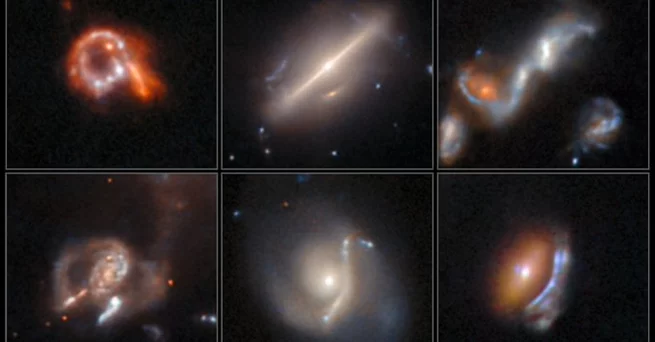
The AI flagged nearly 1,400 anomalies, most of which are interacting or merging galaxies. Others include:
-
Gravitational lenses: Light bent into arcs or rings by massive objects between the observer and distant galaxies.
-
Jellyfish galaxies: Galaxies with long streams of gas resembling cosmic tentacles.
-
Clumpy star-forming galaxies: Galaxies with unusually large clusters of newborn stars.
These discoveries are more than curiosities—they offer clues about galaxy formation, gravitational interactions, and cosmic evolution. According to O’Ryan, Hubble’s archives are “a treasure trove of data in which astrophysical anomalies might be found,” and AI has unlocked this potential like never before.
Why This Matters for Astronomy
AI’s application to Hubble data marks a turning point for astronomy. Massive datasets are no longer an obstacle—they’re an opportunity. Researchers can now investigate rare cosmic events and objects that previously went unnoticed.
By identifying unusual objects quickly, AI allows astronomers to focus on what really matters: understanding how galaxies form, interact, and evolve. It’s not just about speed; it’s about uncovering phenomena that challenge existing models of the universe. Each jellyfish galaxy, each gravitational lens, tells a story about the forces shaping our cosmos.
The Future of AI in Space Research
This discovery demonstrates how AI can complement human expertise. While telescopes continue to capture endless streams of data, AI models like AnomalyMatch will be crucial for scanning, filtering, and prioritizing anomalies for deeper study.
Looking ahead, astronomers hope to apply similar AI methods to datasets from newer observatories, including the James Webb Space Telescope. The goal is to map the universe with unprecedented detail, spotting not just galaxies and stars but the rare and the unexpected.
The union of AI and astronomy is proving to be a game-changer. By automating the search for anomalies, scientists are no longer limited by human observation speeds. From gravitational lenses to galaxies with cosmic “tentacles,” the universe has never been more approachable—or more surprising.





Array