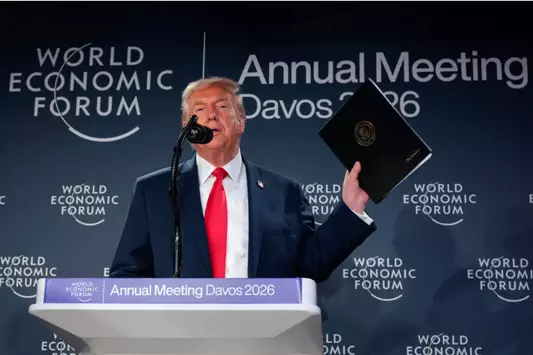
At this year’s World Economic Forum in Davos, global leaders confronted a question many are already asking: how do you lead decisively in a world defined by contradiction? The conversations made clear that today’s challenges are not linear or isolated. Instead, leaders are navigating overlapping inflection points—economic, technological, geopolitical, and human—all at once. While the world remains deeply interconnected, it is also fragmenting along new political and economic lines. Trade barriers are rising even as supply chains stay interdependent. The result is a leadership landscape where certainty is rare, but action is still required.
European Commission President Ursula von der Leyen captured the mood by noting that global trade barriers tripled in value last year alone. Yet despite this fragmentation, economies remain tightly woven together. Leaders are not choosing between globalization and protectionism; they are managing both simultaneously. This tension defines the current era. Compete, yet collaborate. Secure borders, yet keep markets open. These are not transitional dilemmas but enduring realities shaping policy and strategy.
Under pressure, most leadership instincts push toward simplicity. Choose a side. Move fast. Eliminate ambiguity. But in complex systems, binary thinking creates false clarity. Leaders today must act decisively while acknowledging uncertainty, adopt AI while preserving human judgment, and project confidence while staying genuinely open. These paradoxes don’t resolve themselves. They demand leaders who can stay present inside tension without rushing to collapse it.
F. Scott Fitzgerald once wrote that first-rate intelligence is the ability to hold opposing ideas and still function. At Davos, that idea felt less philosophical and more operational. What separates effective leaders now is not charisma or speed, but capacity—the emotional and psychological ability to hold competing truths without freezing or oversimplifying. Many leaders struggle here because paradox triggers fear: fear of being wrong, fear of losing control, or fear of appearing uncertain.
When fear takes over, leaders often retreat to extremes. They adopt rigid positions, tidy narratives, or make premature decisions that silence dissent rather than surface insight. These moves may feel reassuring in the short term, but they weaken long-term outcomes. In volatile environments, collapsing tension too quickly often leads to shortsighted choices. The leaders performing best are resisting that urge and instead strengthening their ability to operate within uncertainty.
WTO Director-General Ngozi Okonjo-Iweala offered a simple but telling reminder to leaders facing policy volatility: don’t hyperventilate. Her call for calm underscored a critical leadership skill—grounded steadiness. Rather than forcing answers, effective leaders are asking better questions. They are naming trade-offs openly, creating space for experimentation, and maintaining momentum without pretending clarity exists where it doesn’t.
Research from Harvard Business School supports what many leaders are experiencing firsthand. Leaders who demonstrate integrative complexity—the ability to recognize multiple perspectives and understand how they interact—are rated as more effective and deliver stronger results. Yet much leadership development still prioritizes speed and decisiveness over ambiguity tolerance. In doing so, organizations risk preparing leaders for a world that no longer exists.
The takeaway from Davos 2026 is clear: leadership today is less about projecting certainty and more about building inner stability. The challenges ahead—from AI disruption to geopolitical instability—cannot be solved with either-or thinking. Leaders who learn to stay present in paradox, delaying false certainty long enough for wiser decisions to emerge, will not just survive disruption. They will shape what comes next. In a fractured world, leadership isn’t about choosing sides. It’s about leading from within the tension—and having the courage to stay there.


Array