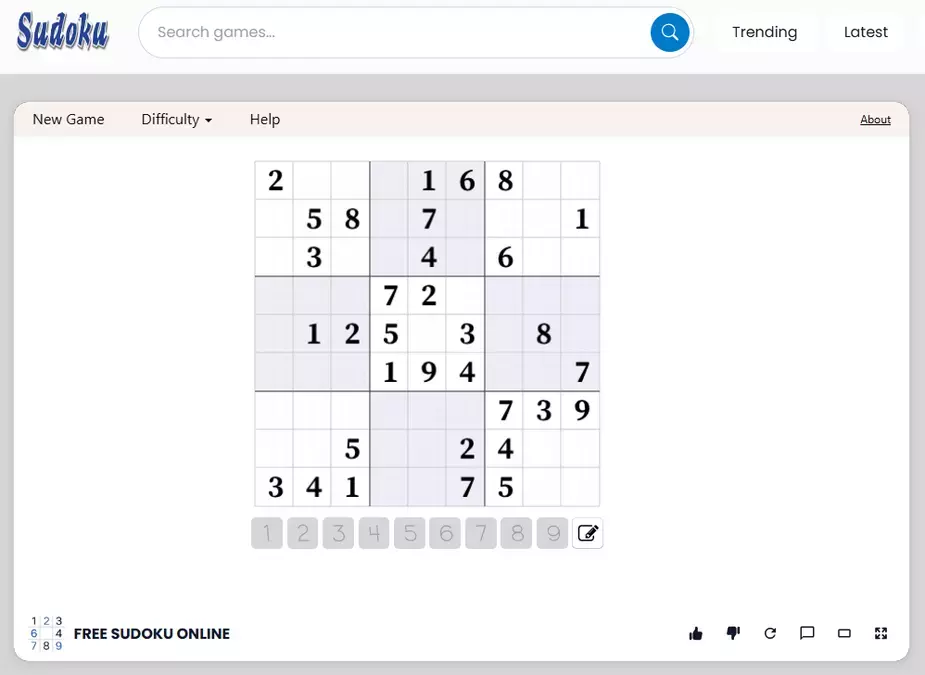
Discover the Exciting World of Sudoku Sudoku is a popular number puzzle game that combines logical thinking, concentration, and problem-solving skills. Easy to understand but challenging to master, Sudoku attracts players of different ages and experience levels. Whether you enjoy solving puzzles during a short break or prefer tackling difficult gri...
Read article
Discover the Exciting World of Sudoku Sudoku is a popular number puzzle game that combines logical thinking, concentration, and problem-solving skills. Easy to understand but challenging to master, Sudoku attracts players of different ages and experience levels. Whether you enjoy solving puzzles during a short break or prefer tackling difficult grids, this classic brain game offers an engaging way to exercise your mind. The main goal of Sudoku is to complete a nine-by-nine grid by placing numbers from 1 to 9 in the correct positions. Every row, column, and three-by-three box must contain each number exactly once. Although the grid may look complicated at first, understanding a few basic rules makes the game much easier to enjoy. Sudoku does not require advanced mathematics or special equipment. Instead, success depends on careful observation, logical deduction, and patience. Each puzzle presents a unique challenge that encourages players to examine possibilities and make thoughtful decisions. How to Play Sudoku Learning how to play Sudoku is straightforward. A standard puzzle contains 81 cells arranged in nine rows and nine columns. Some cells already contain numbers, while the remaining spaces must be completed. Understand the Basic Rules The fundamental rule of Sudoku is simple: every row, column, and three-by-three box must contain the numbers 1 through 9 without repetition. A number cannot appear twice in any of these groups. For example, if a row already contains the numbers 1, 3, 5, and 8, those numbers cannot appear again in the remaining cells of that row. The same restriction applies to the corresponding column and three-by-three box. Players must use these rules to determine which numbers belong in empty cells. Guessing is usually unnecessary because well-designed puzzles provide enough clues to reach a logical solution. Identify Possible Numbers Before filling an empty cell, examine its row, column, and box. Remove every number that already appears in those groups. The remaining numbers become possible candidates. If only one candidate remains, the answer is clear. This technique is especially useful when solving beginner and intermediate puzzles. Writing small candidate numbers in empty cells can also help organize information during more difficult games. Effective Sudoku Strategies for Beginners Developing good habits early can make Sudoku more enjoyable and improve solving speed. Rather than placing numbers randomly, focus on patterns and use the available clues efficiently. Start With Rows, Columns, and Boxes Begin by examining areas that already contain many numbers. A row with seven or eight completed cells often offers an easy opportunity to identify the missing numbers. Next, inspect columns and three-by-three boxes with only a few empty spaces. These areas usually provide straightforward deductions and help establish a strong foundation for the rest of the puzzle. Moving systematically across the grid is more effective than jumping between unrelated cells. A consistent approach reduces mistakes and makes it easier to recognize useful patterns. Use the Process of Elimination The process of elimination is one of the most important Sudoku techniques. Instead of asking which number belongs in a cell immediately, consider which numbers cannot fit. Suppose an empty cell is located in a row containing 2 and 7, a column containing 1 and 5, and a box containing 3 and 8. These numbers are excluded from consideration. The remaining candidates can then be checked against other cells to identify a valid placement. Repeated elimination gradually reduces the number of possibilities until the correct answer becomes clear. Look for Hidden Singles A hidden single occurs when a number can fit in only one cell within a particular row, column, or box, even if that cell contains several possible candidates. For example, the number 6 might appear as a candidate in only one empty cell within a three-by-three box. That cell must contain 6, regardless of its other candidates. Recognizing hidden singles is an important step toward solving more challenging puzzles without relying on guesses. Advanced Sudoku Techniques for Difficult Puzzles As puzzles become more complex, basic scanning may no longer reveal an obvious move. Advanced techniques help players uncover relationships between candidate numbers and eliminate impossible options. Apply Naked Pairs A naked pair appears when two cells in the same row, column, or box contain exactly the same two candidates. If both cells can contain only 2 and 9, those numbers must occupy the two cells in some order. Consequently, 2 and 9 can be removed from the candidate lists of other cells in that group. This technique reduces uncertainty and may reveal additional placements. Naked pairs are useful because they allow players to make progress even when no individual cell has a single candidate. Recognize Interacting Groups Sometimes, a candidate number is restricted to a particular row or column within a three-by-three box. When this happens, the same number can be eliminated from other cells in the corresponding row or column outside that box. This technique, often called locked candidates, helps connect different parts of the grid. It can simplify a puzzle without requiring complex calculations. With regular practice, players become better at spotting these relationships and applying them naturally. Benefits of Playing Sudoku Regularly Sudoku offers more than simple entertainment. It encourages several useful habits that can support everyday learning and mental activity. Improve Concentration and Logical Thinking Solving Sudoku requires sustained attention. Players must remember existing numbers, compare possibilities, and evaluate the consequences of each placement. These activities encourage organized thinking and careful decision-making. Regular practice also helps develop patience because difficult puzzles may require several rounds of observation before a clear move appears. Enjoy a Relaxing Mental Challenge Sudoku can provide a welcome break from busy routines and screen-based distractions. Focusing on a single puzzle gives players a structured activity with a clear objective. Some people enjoy solving Sudoku in the morning, while others prefer a short session during lunch or before bed. The flexible format makes it easy to fit into different schedules. Sudoku should not be viewed as a guaranteed way to prevent cognitive decline, but it can be an enjoyable activity that keeps the mind engaged. Common Sudoku Mistakes to Avoid Even experienced players sometimes make errors that interrupt progress. Understanding common mistakes can help improve accuracy and confidence. Avoid Guessing Too Early Guessing may seem like a quick solution when a puzzle becomes difficult, but an incorrect choice can create several contradictions later. Whenever possible, use candidate elimination and logical patterns before committing to a number. If no clear move is available, review the grid and search for hidden singles, naked pairs, or locked candidates. Check Every Placement Carefully Before entering a number, confirm that it does not duplicate an existing number in the same row, column, or box. Digital Sudoku games may provide automatic error checking, but learning to verify placements independently is valuable. It is also helpful to update candidate notes whenever a new number is placed. Outdated notes can lead to unnecessary confusion. Enjoy Sudoku Online Anytime Online Sudoku makes it convenient to play on computers, tablets, and mobile devices. Many platforms offer multiple difficulty levels, allowing beginners to start with simple puzzles and gradually progress toward expert challenges. Digital versions may include notes, timers, hints, and error indicators. These features can support learning, although players should avoid depending entirely on hints if the goal is to improve independent reasoning. Whether you choose a quick beginner puzzle or a demanding expert grid, the most rewarding approach is to focus on accuracy and enjoy the solving process. Conclusion Sudoku remains a timeless puzzle because it combines simple rules with endless opportunities for logical discovery. By understanding the grid, practicing elimination, and learning advanced techniques, players can gradually improve their skills and solve increasingly difficult challenges. Start with easy puzzles, examine every row and column carefully, and avoid unnecessary guessing. With consistent practice, Sudoku can become a rewarding daily activity that encourages concentration, patience, and structured problem-solving. The key to success is not speed alone but the ability to recognize patterns and make each move with confidence.

 Volaris Airlines Los Angeles International Airport Terminal
 Safe Tree Care in Melbourne: From Pruning to Professional Removal
 Two Reasons You Should Get a Muzzleloader Muzzle Brake
 What Symptoms Can Doctors Reliably Assess Through Telemedicine?
 Home Health Billing in Detroit: Improve Revenue and Reduce Claim Denials
 Aimé Leon Dore Sweatshirts Compared by Graphics, Colors and Design