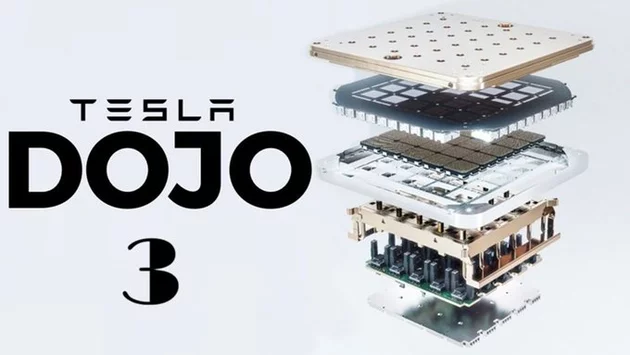
Tesla has officially restarted work on Dojo 3, its most ambitious supercomputer project yet, after earlier attempts failed to deliver the results the company wanted. Many readers are asking what Dojo 3 is, why Tesla paused previous versions, and what this machine will actually be used for. The short answer: Dojo 3 is designed to power Tesla’s next generation of artificial intelligence, relying entirely on in-house chips to train massive AI models more efficiently and at scale.
Tesla Dojo 3 Restart Confirms a Strategic Reset
The restart of Tesla Dojo 3 marks a significant reset rather than a simple continuation of past efforts. Elon Musk confirmed that development is moving forward again now that Tesla’s latest AI chip design has reached a stable and promising stage. Earlier Dojo projects struggled to keep pace with rapidly advancing external AI hardware, making them less competitive than expected.
This time, Tesla is approaching the project with clearer technical foundations and a stronger internal roadmap. Engineers who were previously reassigned are now being brought back, signaling renewed confidence. The company appears willing to reinvest resources after learning hard lessons from earlier missteps.
Why Earlier Dojo Supercomputers Fell Short
Tesla’s first Dojo system quickly lost relevance as competing AI platforms evolved faster. Performance gains elsewhere outpaced Tesla’s internal progress, limiting the practical impact of the system. A follow-up design was eventually shelved before full deployment, highlighting how difficult it is to compete in the fast-moving AI hardware space.
These setbacks were not just about raw speed. Power efficiency, scalability, and software integration also failed to meet Tesla’s long-term needs. Rather than pushing forward with compromised designs, Tesla chose to pause and rethink its strategy.
AI5 Chip Puts Tesla Back in the Race
The renewed confidence behind Dojo 3 is closely tied to Tesla’s AI5 chip, which Musk says is now in good shape. According to internal claims, the AI5 chip is designed to deliver performance comparable to leading AI processors while consuming significantly less power. That balance is critical for large-scale AI training, where energy costs and heat management can limit growth.
By controlling both the chip and the system architecture, Tesla aims to optimize performance at every level. This vertical integration approach mirrors Tesla’s broader philosophy across its products. It also reduces reliance on external suppliers, giving Tesla more flexibility over timelines and design choices.
Dojo 3 Will Be Built Entirely on In-House Hardware
One of the most notable aspects of Dojo 3 is its complete reliance on Tesla-built hardware. Unlike earlier designs that blended internal components with third-party technology, Dojo 3 is expected to be fully self-contained. This makes it Tesla’s most independent supercomputing effort to date.
Such an approach comes with risks, but it also offers long-term rewards. Owning the entire stack allows Tesla to fine-tune systems specifically for its AI workloads rather than adapting generic solutions. Over time, that specialization could translate into meaningful performance and cost advantages.
What Tesla Will Use Dojo 3 For
Dojo 3’s primary mission is training Tesla’s advanced AI models, particularly those related to autonomous driving and robotics. Training these systems requires processing enormous volumes of real-world data, including video and sensor inputs from Tesla vehicles. A purpose-built supercomputer can dramatically shorten training cycles and improve model accuracy.
Beyond vehicles, Dojo 3 is also expected to support Tesla’s broader AI ambitions. This includes work on humanoid robotics and other automation technologies that rely on large-scale machine learning. Faster training means quicker iteration, which is critical in competitive AI development.
Future AI6 and AI7 Chips Show Long-Term Commitment
Tesla’s plans extend well beyond AI5. The company has already outlined future chip generations, referred to as AI6 and AI7, which are expected to deliver incremental improvements over time. Rather than chasing radical redesigns every cycle, Tesla appears focused on steady evolution.
This long-term chip roadmap suggests Dojo 3 is not a one-off experiment. Instead, it is intended to become a foundational platform that grows alongside Tesla’s AI capabilities. That consistency can help attract engineering talent and justify continued investment.
Dojo 3 Highlights Tesla’s High-Stakes AI Strategy
Restarting Dojo 3 underscores how central artificial intelligence has become to Tesla’s future. The company is betting that internal control over AI infrastructure will pay off in performance, cost savings, and strategic independence. It is a bold move in an industry where specialized hardware development is notoriously difficult.
While success is not guaranteed, Tesla now appears better positioned than before. With clearer goals, improved chip designs, and lessons learned from earlier failures, Dojo 3 could finally deliver on the promise that earlier systems could not. For Tesla, this supercomputer is less about bragging rights and more about building the backbone of its next technological era.





Array