Lego Smart Brick Unlocks Hidden Measuring Power
Lego Smart Brick is drawing fresh attention after CES 2026 thanks to a newly revealed feature that answers a key question many fans are asking: what can this brick really do beyond playsets? During a final demo in Las Vegas, Lego quietly showed that the Smart Brick can precisely measure distance, position, and orientation between two bricks in real time. This capability works in both 2D and 3D space and could dramatically expand how Lego is used by adult builders, educators, and engineers. The discovery adds another layer to why the Smart Brick won Best in Show. It also signals that Lego’s ambitions extend far beyond interactive toys. What looked like a simple connected brick now feels like a powerful spatial tool.
A “Lego Ruler” That Measures With Light
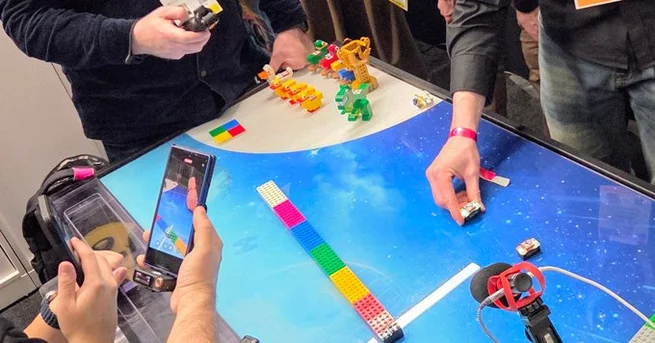
The most striking demonstration involved what Lego designers casually called a “Lego ruler.” Built from standard Lego bricks, the ruler was divided into equal segments of ten studs, roughly eight centimeters each. When a Smart Brick was attached to one end and another Smart Brick slid along the ruler, the bricks changed color at every precise interval. Each color shift happened exactly at the segment boundaries, showing highly accurate distance tracking. No external sensors or cameras were involved in the process. The visual feedback made the measurement intuitive and instantly understandable. This alone hinted at serious potential for creative and technical builds.
Measuring Space Without a Physical Guide
Things became more impressive once the ruler was removed entirely. Using only two Lego Smart Bricks, Lego demonstrated the ability to measure the distance between two points floating freely in space. The bricks tracked their relative positions accurately even when separated by several meters. According to Lego, the system works reliably at distances of up to four to five meters. This opens possibilities for constructing models that respond to spatial relationships rather than fixed connections. It also suggests applications in robotics-style builds and interactive installations. For Lego, this is a major leap from static construction to dynamic spatial awareness.
Orientation Detection Adds Another Layer
Distance wasn’t the only trick on display. When one Smart Brick was rotated in midair, it immediately reacted once it was precisely aligned with the other brick. This showed that the Smart Brick can detect not just proximity, but also orientation and facing direction. Earlier briefings had hinted at basic orientation sensing, but this level of precision was unexpected. The bricks didn’t just know they were close; they knew exactly how they were positioned relative to each other. That kind of awareness could enable far more complex interactions. It’s a capability that feels closer to professional motion-tracking tech than a traditional toy.
Why Kids Won’t See This at Launch
Interestingly, Lego has chosen not to fully showcase this precision in its first Smart Brick sets. The initial Lego Star Wars releases allow ships to interact even when they are not accurately facing one another. Lego’s research shows younger builders prefer forgiving, action-focused play over strict realism. While that decision makes sense for children, it leaves advanced features quietly waiting in the background. Adult fans and educators are likely to be the ones who unlock its full potential. This split approach shows Lego is carefully balancing accessibility with innovation.
A Subtle Hint at Lego’s Future
The Lego Smart Brick now feels less like a novelty and more like a platform. If these precision features hold up outside controlled demos, Lego could be laying the groundwork for a new era of smart construction. From STEM education to advanced hobbyist builds, the possibilities extend far beyond themed sets. What started as a semi-secret demo may become the most important aspect of Lego’s biggest evolution in decades. For builders willing to experiment, the Smart Brick could redefine what Lego means in a connected world.





Comment