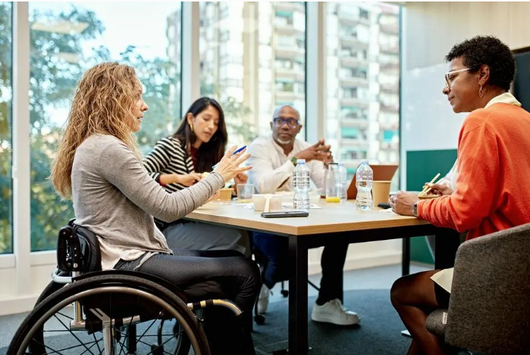
As the International Day of Persons with Disabilities approaches, more leaders are asking how disability, AI, and care connect to the future of work. The short answer is this: they now sit at the center of the global talent strategy. With labor shortages deepening and digital disruption accelerating, companies can no longer afford to treat inclusion as a side initiative. Many organizations still struggle to find skilled workers, even as millions remain locked out of opportunity. This contradiction is becoming one of the most urgent leadership blind spots of our time. In 2026, closing this gap will define which companies grow and which fall behind.
Across Europe, the numbers paint a stark picture of wasted potential and growing urgency. According to the European Commission, only 56% of persons with disabilities participate in the labor market compared to 84% of those without. Instead of shrinking, the employment gap has widened over the past decade to 24%. At the same time, more than 51 million people across the EU remain outside the active workforce. For leaders facing a shrinking talent pool, this is no longer just a social issue. It is a structural business risk hiding in plain sight.
One of the most damaging myths in talent strategy is the assumption that workers with disabilities struggle with fast-moving technology. Research from Randstad shows the opposite is happening in real time. Fifty-five percent of professionals with disabilities already use AI tools to solve problems at work, compared to 39% of their non-disabled peers. For many, voice tools, automation, and predictive workflows are not new experiments but daily productivity engines. This translates into faster adaptation and higher digital confidence. The real risk for employers now is not capability, but underinvestment in AI upskilling.
AI ambition without training quickly turns into frustration. Nearly one-third of workers with disabilities say they would leave their role if they are denied access to AI learning opportunities. That attrition risk is significantly higher than among other employee groups. In a tight labor market, losing your most agile tech adopters is an operational mistake few firms can afford. Leaders who treat AI skilling as optional are quietly accelerating future turnover. Those who prioritize inclusive AI training are building an invisible competitive advantage.
Disability inclusion does not stop with the employee—it extends to families, caregivers, and support systems. The International Labour Organization reports that more than 66% of workers caring for dependents with disabilities feel burned out or overwhelmed. Many firms already have caregiver policies, but awareness and access remain dangerously low. Only about 41% of eligible workers even know these supports exist. When care is treated as a private burden, performance silently erodes. When it is openly supported, productivity and loyalty rise together.
Organizations that normalize care conversations consistently outperform those that ignore them. Flexible schedules, caregiver leave, and mental health support only work when managers actively encourage their use. Training leaders to spot burnout early prevents long-term disengagement and costly exits. Seventy-five percent of companies report productivity gains after strengthening care policies. In practical terms, care is no longer just a benefit—it is infrastructure. A care-aware culture is now a core retention system.
Most hiring barriers for people with disabilities have little to do with capability and everything to do with rigid systems. Employers consistently overestimate accommodation costs while underestimating human potential. At the policy level, outdated benefit structures often punish people financially for accepting work. This “benefit trap” forces many into an impossible choice between stability and opportunity. Real inclusion begins with reengineering recruitment, benefits, and workplace design. When processes evolve, performance follows.
In Spain, companies with more than 50 employees must ensure that at least 2% of their workforce includes persons with disabilities. This mandate sparked innovation far beyond basic compliance through initiatives like the Fundación Randstad Social Innovation Hub. Tools such as sensory-adapted workspaces and magnetic loops are now closing digital skill gaps at scale. The business results are clear: inclusive companies post up to 28% higher profits. When barriers disappear, resilience and adaptability rise fast.
The next chapter of the talent war will not be won by searching in the same familiar places. Leaders can either repeat yesterday’s hiring strategies or unlock new growth by widening their lens today. Workers with disabilities are already leading in AI adoption and demonstrating exceptional resilience. Care-aware cultures are already outperforming on retention and productivity. The only missing ingredient is leadership intent. In 2026, the companies that win will be those that finally align disability, AI, and care into one unified talent strategy.
𝗦𝗲𝗺𝗮𝘀𝗼𝗰𝗶𝗮𝗹 𝗶𝘀 𝘄𝗵𝗲𝗿𝗲 𝗿𝗲𝗮𝗹 𝗽𝗲𝗼𝗽𝗹𝗲 𝗰𝗼𝗻𝗻𝗲𝗰𝘁, 𝗴𝗿𝗼𝘄, 𝗮𝗻𝗱 𝗯𝗲𝗹𝗼𝗻𝗴. We’re more than just a social platform — from jobs and blogs to events and daily chats, we bring people and ideas together in one simple, meaningful space.



Comments